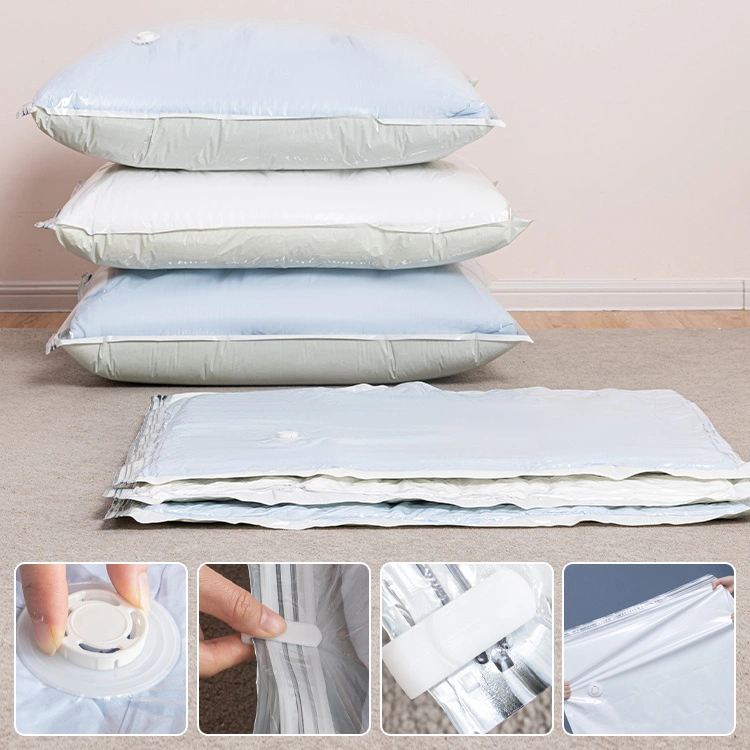
High-flow vs. standard air valves for vacuum compression bags is a comparison about more than packing speed. Valve design influences how easily air escapes, how securely the bag closes, and whether your vacuum cleaner or portable pump connects correctly. However, a faster valve does not automatically deliver better compression or longer-lasting storage.
My recommendation is to evaluate the complete bag system: valve, zipper, film, seams, and compatible pump. For households, that means less frustration when packing bedding. For retailers and sourcing teams, it means choosing specifications that customers can verify—not simply a larger valve or a stronger marketing claim.
This guide explains the practical differences, identifies where high-flow designs provide value, and outlines a straightforward comparison method.
High-Flow vs. Standard Air Valves: Quick Comparison
“High-flow” and “standard” are useful product descriptions, but they do not establish a universal performance rating. Compare individual products under equivalent conditions.
| Comparison point | High-flow air valves | Standard air valves |
|---|---|---|
| Primary design priority | Reduce airflow restriction during evacuation | Provide a conventional evacuation and closure interface |
| Compression speed | Potentially faster when the valve limits airflow | May be adequate for smaller loads or occasional use |
| Final compressed size | Not necessarily smaller | Can achieve comparable compression with suitable equipment |
| Long-term sealing | Depends on closure design and manufacturing quality | Also depends on closure design and manufacturing quality |
| Pump compatibility | May require a specific nozzle or adapter | Also varies by brand and model |
| Typical buying rationale | Convenience when processing bulky or multiple bags | Simplicity and satisfactory everyday performance |
| Evidence to request | Matched evacuation, retention, and reuse tests | The same matched tests |
The central distinction is simple: evacuation speed describes how quickly air leaves; compression retention describes how well the bag stays compressed. Treat them as separate purchasing criteria.
How Air Valves for Vacuum Compression Bags Work
A vacuum compression bag shrinks because removing air reduces its internal pressure. Atmospheric pressure then pushes the flexible bag against the contents.
The valve provides an evacuation pathway and a mechanism for limiting air re-entry. Depending on the design, that mechanism may involve a flexible membrane, a rotating closure, a cap, or several components working together.
The zipper seals the loading opening, while the film and seams complete the enclosure. A reliable valve cannot compensate for an incompletely closed zipper or a puncture.
What Makes a High-Flow Valve Different?
A high-flow design aims to let air pass with less restriction. Possible design approaches include a larger effective opening, a less obstructed internal pathway, or a sealing element that opens more readily during evacuation.
External diameter alone is not enough to judge performance. A wide valve can still contain a restrictive internal passage. Likewise, an efficient smaller valve may work well with a correctly matched pump.
Request product-specific evidence rather than assuming that every upgraded or oversized valve offers the same benefit.
What Is a Standard Air Valve?
A standard valve generally refers to the conventional design used as a product’s comparison baseline. It is not necessarily outdated or unreliable.
Many conventional vacuum storage bags use a one-way evacuation mechanism with an additional closure. Others use integrated configurations. Follow the actual instructions: some valves require tightening after evacuation, while others operate differently.
For occasional clothing storage, a well-made standard valve may provide everything the user needs.
Six Differences That Matter in Everyday Use
1. Air Removal Speed
High-flow valves are most useful when valve resistance is a meaningful bottleneck.
If a household vacuum can move more air than the valve allows through, reducing that restriction may shorten evacuation. However, a weak pump, leaking nozzle connection, or blocked internal pathway can limit the improvement.
A fair comparison therefore uses the same pump, bag dimensions, textile load, and endpoint. Without these controls, “faster” may describe the test setup rather than the valve.
2. Final Compression
Faster air removal does not necessarily produce a smaller final package.
Final dimensions also depend on the contents, achievable pressure, remaining air pockets, and how easily air can travel through the packed textiles. Two bags can reach similar compressed sizes at different speeds.
For bulky bedding, compare both evacuation time and final thickness. For travel clothing, usability may matter more than a small difference in compressed dimensions.
3. Long-Term Airtightness
Neither valve category guarantees better storage retention.
Air can enter through the valve, zipper, seams, or damaged film. The closure may also be affected by contamination or incorrect operation.
From a specification standpoint, “compresses quickly” and “stays compressed” should always be separate claims. A strong purchasing decision requires evidence for both.
4. Pump and Vacuum Compatibility
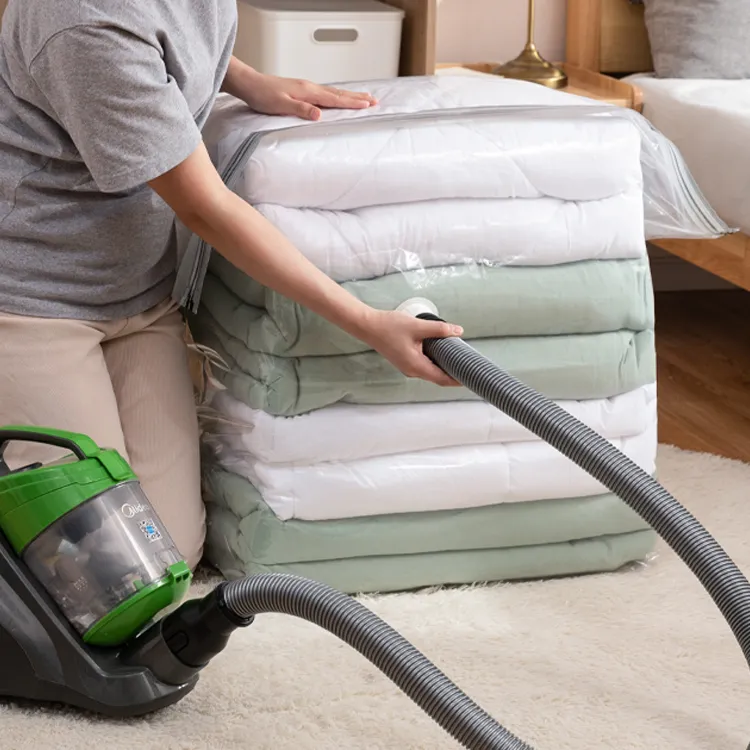
A fast valve provides little convenience if the available nozzle cannot seal against it.
Check:
- Nozzle dimensions and connection shape.
- Whether an adapter is included.
- Compatibility with the intended hand or electric pump.
- Whether the user must hold the connection throughout evacuation.
- Any restrictions in the vacuum cleaner’s operating instructions.
Avoid treating “universal” compatibility as a substitute for checking the actual equipment.
5. Reusability and Handling
Repeated opening, evacuation, closure, and storage challenge the entire bag.
Evaluate the zipper, valve attachment, membrane, closure components, and film around the valve. Removable parts may be misplaced; integrated parts still need correct operation.
A useful reuse trial should reproduce real handling rather than repeatedly evacuating an untouched sample on a clean bench.
6. Purchase Price and Operating Value
High-flow designs are not automatically more expensive, and standard designs are not automatically better value. Pricing depends on materials, construction, accessories, order quantity, and supplier positioning.
For occasional household use, a modest speed improvement may have limited value. For businesses processing many bags, time savings can matter more.
Compare total cost with packing time, replacement frequency, customer complaints, and accessory requirements—not valve price alone.
Which Valve Should You Choose?
For Comforters, Blankets, and Bulky Bedding
Consider high-flow vacuum compression bags when large loads take too long to evacuate.
Choose an appropriately sized bag first. Avoid forcing oversized contents into a smaller bag, and keep the valve area unobstructed.
The best option is the one that combines practical evacuation speed with dependable closure and suitable film construction.
For Travel and Small Clothing Loads
Prioritize return-trip convenience.
A bag that works well with a household vacuum may be inconvenient where no compatible vacuum is available. A matching compact pump or a specifically designed manual-compression system can be more useful than maximum evacuation speed.
Do not assume that every high-flow bag can be compressed by hand. That capability must be part of the product design.
For Frequent Packing or Commercial Use
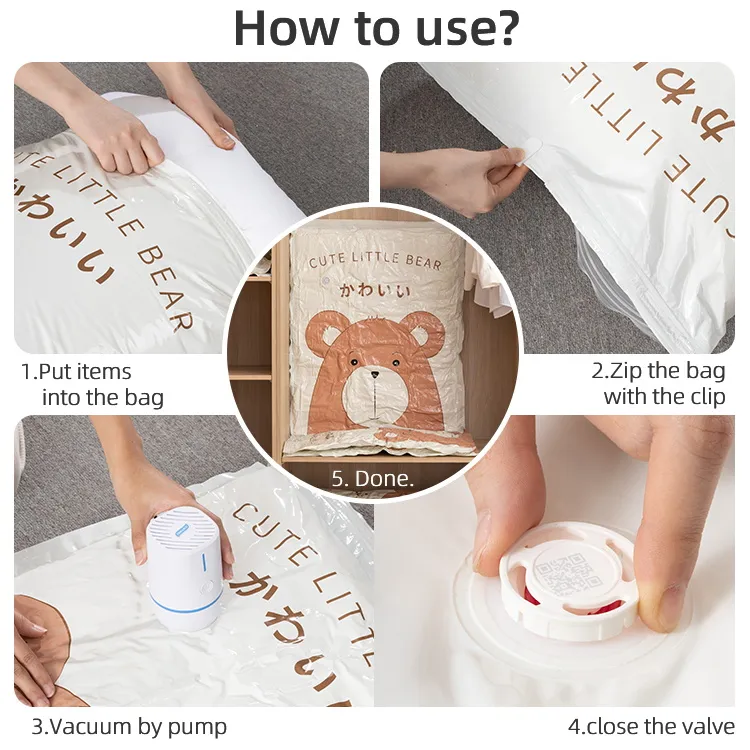
Evaluate the complete workflow: loading, zipper closure, pump connection, evacuation, disconnection, and final valve closure.
A valve may evacuate faster yet require more connection time. Conversely, an easier interface may improve the workflow even when the evacuation difference is modest.
For purchasing teams, total seconds per completed bag is often more informative than suction time alone.
A Practical Test Protocol for Comparing Valve Performance
This proposed screening protocol helps buyers make controlled comparisons. It is not a published certification method.
Step 1: Match the Samples
Use comparable bag dimensions and identical textile loads. Keep folding, filling level, pump, nozzle, and room conditions consistent.
Test several samples of each design. One unusually good or defective bag should not determine the decision.
Step 2: Define the Endpoint
Decide what “finished” means before timing.
For practical screening, use a defined package thickness or another repeatable endpoint. Instrumented laboratory comparisons can use a suitable pressure endpoint.
Avoid judging completion only by appearance.
Step 3: Record the Whole Workflow
Measure setup time, evacuation time, disconnection time, and any required closure step.
Also note awkward handling, adapter slippage, repeated attempts, and immediate air re-entry.
Step 4: Check Retention
Record package dimensions immediately after compression and at selected later intervals, such as 24 hours and seven days.
These are proposed screening intervals, not universal acceptance requirements. Textile recovery and temperature can affect dimensions, so visible expansion alone does not identify the leak location.
Step 5: Repeat After Reuse
Run the same comparison after repeated opening and closing. Document failures separately: zipper problems, valve leakage, punctures, seam damage, and connection difficulties.
This produces more useful purchasing evidence than a single speed demonstration.
How to Read Speed Claims Without Being Misled
Manufacturer pages sometimes advertise compression in seconds or claim a multiple of conventional-valve speed. Those figures need context.
For example, a TAILI retail product page advertises nine-second compression and includes a three-times-faster valve comparison in its product content. These remain manufacturer claims for the relevant products and conditions—not universal results for every TAILI bag or high-flow valve.
Before adopting a numerical claim, ask:
- What bag size and textile load were tested?
- Which vacuum or pump was used?
- What defined the end of compression?
- Which conventional valve served as the baseline?
- How many samples and repetitions supported the result?
Independent consumer testing provides another perspective. Better Homes & Gardens reported negligible expansion after 24 hours for tested TAILI hanging bags. That observation concerns a particular product and test period; it does not establish a general high-flow-versus-standard advantage.
What Laboratory Leak Testing Can—and Cannot—Prove
For commercial qualification, a visual retention check may not provide enough information.
ASTM F2338 describes nondestructive package leak detection using vacuum decay. Its scope includes flexible, nonporous packages. In this method, equipment monitors pressure changes in an evacuated chamber containing the package.
However, a reusable textile-storage bag requires an appropriate test setup and validated acceptance criteria. A bag with little remaining headspace may need special consideration.
Ask suppliers to distinguish between:
- Internal storage-retention checks.
- Instrumented leak testing.
- Testing conducted according to a named method.
- Independent laboratory verification.
A reference to a standard is not proof that a specific product passed it.
How TAILI’s Materials Background Fits the Decision
TAILI’s official company profile identifies its establishment in 2003 and reports more than 1,200 patents. Its product materials describe vacuum storage designs combining valves, zipper closures, and multilayer bag materials.
That background makes an integrated evaluation especially relevant. Buyers should assess how the material structure, closure system, valve, and intended evacuation method work together.
Some TAILI products offer both manual and vacuum compression, while other product instructions specify rotating the valve closed after evacuation. These differences reinforce why model-specific guidance matters.
For sourcing discussions, request specifications and evidence for the exact product under consideration. A company’s technical background provides context, but it does not replace product-level speed, retention, or durability results.
Choose Verified Performance, Not Just a Valve Label
High-flow valves can improve convenience, particularly for bulky loads and repeated packing. Standard valves remain a sensible choice when they deliver adequate speed and dependable storage.
Contact TAILI with your intended contents, bag dimensions, evacuation equipment, and storage duration. Request matched samples and product-specific speed, retention, and reuse evidence before selecting your household, retail, or OEM configuration.

Frequently Asked Questions
Are high-flow air valves always better than standard valves?
No. They may reduce evacuation time, but overall value depends on sealing reliability, compatibility, handling, and price. A good standard valve can be entirely suitable for occasional storage.
Do high-flow valves make vacuum compression bags smaller?
Not necessarily. They primarily address airflow during evacuation. Final size also depends on the load, pump, bag construction, and achievable internal pressure.
Do larger valves leak more easily?
Valve size alone does not establish leakage risk. Closure design, component quality, contamination, assembly, and correct operation all matter. Compare retention results rather than appearance.
Can I use any vacuum cleaner with either valve?
Do not assume compatibility. Check the bag instructions, nozzle fit, adapter requirements, and vacuum cleaner guidance. A poor connection can reduce performance regardless of valve type.
Why does my vacuum storage bag reinflate?
Possible causes include an incompletely closed zipper, incorrectly secured valve, trapped fibers, punctures, or damaged seams. Check each area systematically rather than immediately blaming the valve.
Can I compress a high-flow bag without a pump?
Only if the product is designed for manual compression. High airflow and pump-free operation are different features. Follow the instructions for the specific bag.
References
1. ASTM International — ASTM F2338-09(2020): Standard Test Method for Nondestructive Detection of Leaks in Packages by Vacuum Decay Method. Primary reference for the laboratory method, scope, and acceptance-criteria principles discussed above.
2. TAILI Technology — About TAILI. Official company profile. Source for the founding year and company-reported patent count.
3. TAILI Store — TAILI Clear Extra Large Cube Vacuum Storage Bags. Manufacturer source for product construction, manual/vacuum operation, and advertised speed claims; not independent comparative validation.
4. TAILI Group — TAILI Hanging Vacuum Storage Bags. Manufacturer instructions covering the upgraded valve, vacuum compatibility, zipper construction, and rotating closure operation.
5. Better Homes & Gardens — The Winners of Our Best Vacuum Storage Bags Tests. Independent consumer testing, including reported 24-hour retention observations for TAILI hanging bags.
6. The Spruce — After Testing Vacuum Storage Bags, These 6 Are Our All-Time Favorites. Consumer-testing context for pump connection, sealing, overfilling, and practical operation.
Hot Tags: Vacuum Compression Bags, Vacuum Storage Bags, Vacuum Storage Bag Manufacturer, Vacuum Compression Bags Wholesale, OEM Vacuum Storage Bags, Custom Vacuum Storage Bags, High-Flow Vacuum Bag Valves, Vacuum Storage Bag Valves, Reusable Vacuum Storage Bags, Vacuum Storage Bags Bulk