Content Menu
● Why a Fully Closed Zipper Does Not Guarantee an Airtight Bag
● Compression Bag Losing Air: A Quick Troubleshooting Table
● Seven Reasons Your Vacuum Storage Bag Keeps Expanding
>> 1. The Zipper Tracks Are Not Completely Engaged
>> 2. Hair, Lint, or Fabric Is Interrupting the Seal
>> 3. The Air Valve Is Not Secured Correctly
>> 5. A Tiny Puncture Is Letting Air Back In
>> 6. A Seam or Valve Attachment Is Damaged
>> 7. Slow Air Entry Is Being Confused With Sudden Failure
● How to Fix a Compression Bag That Will Not Stay Compressed
>> Step 2: Repack With Less Material
>> Step 3: Clean and Reseal the Zipper
>> Step 4: Remove Air Using the Correct Method
>> Step 5: Observe Before Putting It Away
● A Simple Comparison Test to Identify a Faulty Bag
● Can You Repair a Leaking Vacuum Storage Bag?
● What Material Quality Can—and Cannot—Tell You
● How to Prevent Compression Bags From Losing Their Seal
● Get Help With the Right Bag—not Just a Stronger Pump
>> Why does my compression bag inflate overnight?
>> Can a fully zipped vacuum bag still leak?
>> Should I keep vacuuming until the bag feels completely rigid?
>> Do all vacuum storage valves close automatically?
>> How long should a vacuum storage bag stay compressed?
>> Can I store a down sleeping bag compressed all year?
Your compression bag is losing its vacuum because air can enter through more than the zipper. An incorrectly secured valve, a tiny puncture, a damaged seam, or a small gap between zipper tracks can let a vacuum storage bag expand again—even when the slider has reached the end.
Strictly speaking, the bag is not “losing air.” It is losing compression as air returns. That distinction matters: pumping harder will not fix an opening that remains unsealed.
My troubleshooting approach is to check the entire sealing system, not just the zipper. Start with the closure, move to the valve, and then inspect the film and seams. This guide focuses on airtight vacuum compression bags for clothing and bedding, rather than fabric compression packing cubes.
Why a Fully Closed Zipper Does Not Guarantee an Airtight Bag
A slider reaching the end only confirms that it has traveled across the closure. It does not prove that every section of the interlocking tracks has engaged.
A strand of hair, trapped fabric, or a wrinkle can interrupt contact. Overpacking can also pull the mouth of the bag out of alignment.
Think of airtightness as a system with four connected parts:
- Zipper tracks that engage continuously.
- A valve secured according to its design.
- Intact plastic film without punctures.
- Undamaged seams and component attachment points.
A problem in any one area can undermine the whole bag. The most useful first step is therefore inspection—not immediately replacing the pump.
Compression Bag Losing Air: A Quick Troubleshooting Table
Use the symptoms below to prioritize your checks. They are diagnostic clues, not proof of a particular defect.
| What you notice | What to inspect first | Practical next step |
|---|---|---|
| Bag expands soon after pumping | Zipper engagement and valve position | Reopen, clean, reseal, and check instructions |
| Bag holds until it is moved | Contact damage or strain | Inspect folds, corners, and storage surfaces |
| Zipper area looks stretched | Excessive filling | Remove items or choose a larger bag |
| Only one bag repeatedly fails | Damage or a bag-specific defect | Compare it with a known-good bag |
| Several bags fail after the same routine | Packing or valve operation | Review the instructions for that exact model |
| Bag gradually softens during storage | Small leakage or long-term air entry | Inspect and compare with stated retention claims |
Seven Reasons Your Vacuum Storage Bag Keeps Expanding
1. The Zipper Tracks Are Not Completely Engaged
This is the first area I would inspect, even if the zipper looks closed.
Open the closure completely. Lay the opening flat, then move the supplied slider slowly across the full length. Repeat as directed by the manufacturer.
Next, pinch along the tracks with your fingers. Pay particular attention to both ends, where a short unsealed section is easy to overlook.
Avoid forcing the slider across a stretched or folded opening. A careful second pass is more useful than applying excessive pressure.
2. Hair, Lint, or Fabric Is Interrupting the Seal
A closure can look neat from above while a thread lies between its sealing surfaces.
Inspect both tracks in good light. Remove:
- Loose hair.
- Fluff from towels or blankets.
- Garment threads.
- Dust and small debris.
- Fabric caught near the opening.
Wipe the accessible surfaces with a clean, soft cloth. Let any cleaned area dry before resealing.
Do not apply oil, petroleum jelly, or household adhesive to improve the seal unless the manufacturer specifically permits it. These are not substitutes for correctly engaged tracks.
3. The Air Valve Is Not Secured Correctly
A perfectly sealed zipper cannot compensate for an open valve.
Valve designs differ. Some use screw caps; others require a particular twist or closure action. Do not assume that a cap-free design automatically needs no action after compression.
For example, TAILI’s Clean Cube instructions describe opening the valve, pressing out the air, and then closing the valve. The correct sequence depends on the product.
Keep clothing away from the valve opening. Check accessible surfaces for debris, but do not pry apart an internal membrane or remove components unless the instructions allow it.
4. The Bag Is Overfilled
Overfilling makes several problems more likely at once: the zipper becomes harder to align, bulky fabric crowds the valve, and handling places more strain on the bag.
A useful check is whether the opening lies flat before you close it. If you must pull the sides together forcefully, reduce the load.
Follow the printed fill line or the manufacturer’s specified clearance. There is no universal gap suitable for every bag.
For a large duvet, choosing a larger bag is usually more practical than forcing the duvet into a smaller one.
5. A Tiny Puncture Is Letting Air Back In
Small holes can be difficult to see, especially in printed film or deep folds.
Inspect areas that contact:
- Clothing zippers and metal fasteners.
- Rough shelving.
- Basket edges.
- Suitcase hardware.
- Sharp objects stored nearby.
Spread the emptied bag across a smooth surface and examine it under good lighting. Turn it over and inspect both sides.
Do not drag a compressed bag across the floor. Lift and support it instead, particularly when it contains heavy bedding.
6. A Seam or Valve Attachment Is Damaged
Sometimes the closure works correctly, but air enters where two materials join.
Inspect the perimeter seams, zipper ends, and the area surrounding the valve. Look for separation, tears, distortion, or damage that becomes visible when the film lies flat.
From a manufacturing perspective, this distinction is important: durable film alone cannot guarantee a reliable finished bag. The closure, valve, seams, and assembly quality must work together.
A separating seam or damaged valve attachment generally warrants replacement rather than an improvised household repair.
7. Slow Air Entry Is Being Confused With Sudden Failure
A bag that expands quickly presents a different problem from one that gradually softens over an extended storage period.
Neusu notes that some air can enter vacuum storage bags over time and recommends periodic recompression. That does not establish an acceptable leakage rate for every brand or model.
Judge performance against the product’s own claims. A bag that becomes bulky again shortly after careful sealing deserves investigation; repeated pumping should not replace troubleshooting.
How to Fix a Compression Bag That Will Not Stay Compressed
The following sequence helps avoid changing several things at once.
Step 1: Unpack and Inspect
Remove the contents so you can examine the zipper, valve, film, and seams without tension.
Check whether any sharp garment hardware could have pressed against the plastic.
Step 2: Repack With Less Material
Use clean, completely dry items.
Distribute them evenly and leave the required clearance around the closure. Keep thick folds away from the valve.
Step 3: Clean and Reseal the Zipper
Clear both tracks, align the opening, and close it slowly.
Check the full length manually, including both ends.
Step 4: Remove Air Using the Correct Method
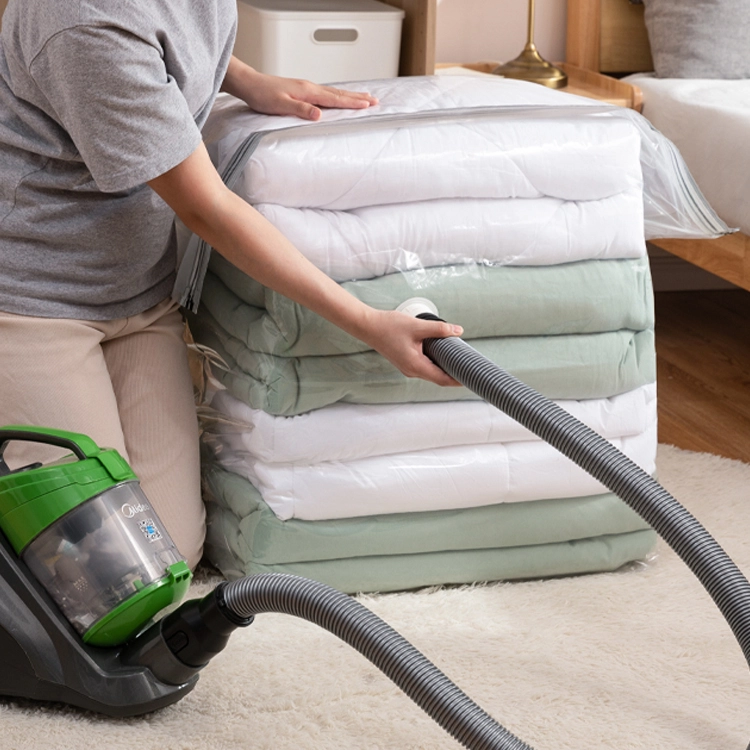
Use the compatible pump, vacuum attachment, or manual compression method specified for the bag.
A poor connection can make evacuation inefficient. However, a more powerful pump will not repair a leaking closure.
Stop according to the product instructions, then secure the valve.
Step 5: Observe Before Putting It Away
Leave the compressed bag on a smooth surface where you can inspect it.
Photograph its initial shape and check it later under similar conditions. Do not immediately squeeze it into a crowded cupboard, where handling damage could complicate the diagnosis.

A Simple Comparison Test to Identify a Faulty Bag
When the leak remains unclear, I recommend a controlled comparison rather than repeated guesswork.
This is a suggested household screening method, not a certified performance test.
- Select the suspect bag and a similar bag that has worked reliably.
- Fill both with comparable quantities of dry clothing.
- Follow each bag’s sealing instructions.
- Place them together on the same smooth surface.
- Photograph them immediately, after one hour, and the following morning.
- Record any visible expansion.
If only the suspect bag expands substantially, a bag-specific problem becomes more plausible.
If both expand, review the shared packing method, valve operation, and handling conditions before concluding that both products are defective.
Avoid testing an entirely empty bag as your only check. It does not reproduce the loading and handling conditions of normal use.
Can You Repair a Leaking Vacuum Storage Bag?
The answer depends on the location and extent of the damage.
| Condition | Sensible response |
|---|---|
| Dirty zipper tracks | Clean and reseal |
| Incorrect valve position | Follow the model-specific closing procedure |
| Overfilled bag | Reduce the load |
| Small puncture in otherwise sound film | Ask whether an approved patch is available |
| Split seam | Replace the bag |
| Torn zipper track | Replace the bag |
| Cracked valve or damaged attachment | Contact the supplier about replacement |
Treat generic tape as an uncertain temporary measure, not a restored performance guarantee.
Avoid heat-sealing, ironing, or modifying the valve at home unless the manufacturer supplies a specific repair procedure.
For a recently purchased bag, photograph the issue and contact the seller before attempting modifications that could complicate a warranty claim.
What Material Quality Can—and Cannot—Tell You
When comparing vacuum storage bags, it is tempting to focus on thickness or a headline compression percentage. Neither tells the whole story.
The more useful question is whether the complete product performs reliably under its intended conditions.
TAILI describes its Clean Cube bags as combining multilayer material, a reinforced zipper seal, and a leak-resistant valve. Those features address different parts of the same sealing system.
The company background supplied for this article describes Guangdong Taili Technology Group as a materials-focused business with capabilities spanning research and manufacturing. That context is relevant, but household product claims should still be supported by evidence for the specific model.
For purchasing teams, useful questions include:
- Under what conditions was air retention evaluated?
- What load and bag size were used?
- Was performance checked after repeated opening and closing?
- What instructions and replacement support are provided?
These questions produce more actionable answers than asking whether a bag is simply “leakproof.”
How to Prevent Compression Bags From Losing Their Seal
Build a repeatable routine:
- Check the film and closure before reuse.
- Pack within the stated capacity.
- Keep tracks clean and flat.
- Keep bulky contents away from the valve.
- Follow the correct valve-closing sequence.
- Lift compressed bags instead of dragging them.
Also consider whether compression suits the contents.
For sleeping bags, REI recommends dry, loose storage in a breathable sack between trips. Prolonged compression can reduce the loft of both down and synthetic insulation. A bag remaining airtight does not automatically mean its contents should remain compressed indefinitely.
Get Help With the Right Bag—not Just a Stronger Pump
Before replacing your equipment, complete the zipper–valve–film inspection.
For an unresolved TAILI bag issue, contact the seller or TAILI support with the model name, purchase details, photographs, and the time it takes to expand. Request model-specific troubleshooting or replacement guidance.
For bulk purchasing, request the applicable instructions, retention-test conditions, and repeated-use information before choosing a product.
Frequently Asked Questions
Why does my compression bag inflate overnight?
Inspect the zipper, valve, film, and seams. Overnight expansion can indicate an unsealed section or damage. Reduce the load, reseal carefully, and compare it with a known-good bag.
Can a fully zipped vacuum bag still leak?
Yes. The tracks may not be completely engaged, or air may enter elsewhere. Slider position alone does not establish airtightness.
Should I keep vacuuming until the bag feels completely rigid?
Follow the product instructions rather than aiming for maximum rigidity. Continued pumping will not fix an opening that allows air to return.
Do all vacuum storage valves close automatically?
No. Closing procedures vary. Some designs require a cap or twisting action after air removal. Check the instructions printed on your exact bag.
How long should a vacuum storage bag stay compressed?
There is no universal duration. Construction, use, handling, and storage conditions vary. Compare performance with the manufacturer’s stated retention claim and maintenance guidance.
Can I store a down sleeping bag compressed all year?
That is not recommended. REI advises storing sleeping bags dry and loosely in a breathable sack between trips to help preserve insulation loft.
References
1. Neusu — How to Use Vacuum Storage Bags Properly. Manufacturer guidance covering loading clearance, valve operation, and gradual air entry during storage.
2. Neusu — Vacuum Storage Bag Tips. Practical instructions on zipper engagement, checking closure ends, and avoiding overfilling.
3. TAILI — TAILI Clean Cube Vacuum Storage Bags. Product information describing the closure, multilayer construction, and valve operating sequence. Manufacturer-reported features, not independent test results.
4. Packmate — How to Stop Vacuum Bags From Leaking Air. Manufacturer troubleshooting guidance covering closures, valves, punctures, and handling.
5. REI Co-op — How to Store a Sleeping Bag. Specialist guidance on drying, loose storage, and the effects of prolonged compression on insulation.
Hot Tags: Vacuum Storage Bags, Compression Bag Manufacturer, Vacuum Storage Bag Supplier, Wholesale Vacuum Storage Bags, OEM Vacuum Storage Bags, Custom Vacuum Storage Bags, Airtight Storage Bags, Reusable Vacuum Storage Bags, Vacuum Bags For Bedding, Vacuum Compression Bags