Content Menu
● Built-In Electric Pumps vs. Manual Pumps: Quick Comparison
● What Counts as a Built-In Electric Pump?
>> Integrated pumps and included pumps are different
>> How manual vacuum pumps work
● Compression Performance: Does Electric Always Mean Better?
>> Compare the final packed result
>> Air retention deserves a separate test
● Packing Speed, Effort, and Everyday Convenience
>> Electric pumps suit repeated packing
>> Manual pumps suit smaller packing tasks
● Portability, Battery Planning, and Air Travel
>> Compare total system weight
>> Check battery rules before flying
>> Keep an inspection recovery plan
● Reliability, Maintenance, and Long-Term Value
>> Integrated convenience can create repair trade-offs
>> Manual pumps still need quality control
● A Practical Home Test: Compare Both Pumps Fairly
>> Step 1: Standardize the clothing load
>> Step 2: Time the complete packing process
>> Step 3: Check shape and air retention
>> Step 4: Repeat after reopening
● Which Pump Is Better for Your Travel Style?
>> Frequent business trips and multi-city travel
>> Occasional holidays and smaller budgets
>> Camping and travel with limited electricity
● What TAILI’s Materials Background Means for Buyers
● Final Recommendation and Next Step
>> 1. Do electric pumps compress travel vacuum bags more than manual pumps?
>> 2. Can I use a manual pump with an electric-pump bag?
>> 3. Are built-in electric pumps the same as rechargeable pumps?
>> 4. Can airport security open vacuum-packed clothing?
>> 5. Why does my vacuum bag expand after packing?
>> 6. Which option is better for frequent repacking?
Built-in electric pumps vs. manual pumps for travel vacuum bags: which option makes packing easier? Electric pumps reduce repetitive effort, while manual pumps work without charging. The better choice depends on how often you repack, how many bags you carry, and whether your priority is convenience, simplicity, or independence from electricity.
My recommendation is to choose the system, not just the pump. A powerful motor cannot compensate for a leaking zipper. Likewise, a basic hand pump can serve you well when it matches a well-made bag and a manageable packing routine.
This guide compares both options from a practical product-selection perspective. It does not present laboratory measurements or personal travel tests; performance varies by model, clothing load, valve design, and operating conditions.
Built-In Electric Pumps vs. Manual Pumps: Quick Comparison
| Comparison point | Built-in electric pump | Manual pump |
|---|---|---|
| Operation | A motor removes air through the bag’s valve | Repeated hand movements remove air |
| Main advantage | Less repetitive physical effort | No battery or charging dependency |
| Packing speed | Potentially faster; model and load dependent | Depends on pump design and user effort |
| Portability | Integrated hardware stays with the bag | Separate pump must be packed |
| Energy supply | Battery or external power, depending on design | Human power |
| Noise | Motor noise during operation | No electric motor noise |
| Maintenance | Charging, electrical care, and valve inspection | Mechanical, seal, and valve inspection |
| Repair flexibility | Integrated components may be harder to replace | A compatible replacement pump may be easier to source |
| Best-fit traveler | Frequent repacker or convenience-focused traveler | Occasional traveler or off-grid user |
| Main limitation | Battery availability and component complexity | Repeated pumping can become tiring |
Neither category guarantees stronger compression or better overnight air retention. Those outcomes require testing the complete bag-and-pump combination.
What Counts as a Built-In Electric Pump?
Integrated pumps and included pumps are different
A built-in electric pump is physically integrated into the bag or its valve assembly. Depending on the design, the motor module may be permanently attached or removable.
An included electric pump is a separate accessory supplied with the bags. A rechargeable battery inside that accessory does not make the pump integrated into the bag.
This distinction matters when comparing products. For example, TAILI’s travel compression bag listing describes an included portable electric pump. That description alone does not establish a permanently integrated pump design.
Before purchasing, ask:
- Is the pump attached, removable, or completely separate?
- Does each bag need its own motor module?
- Can one pump operate several bags?
- Can the bag be compressed if the motor fails?
- Are replacement pumps and compatible adapters available?
How manual vacuum pumps work
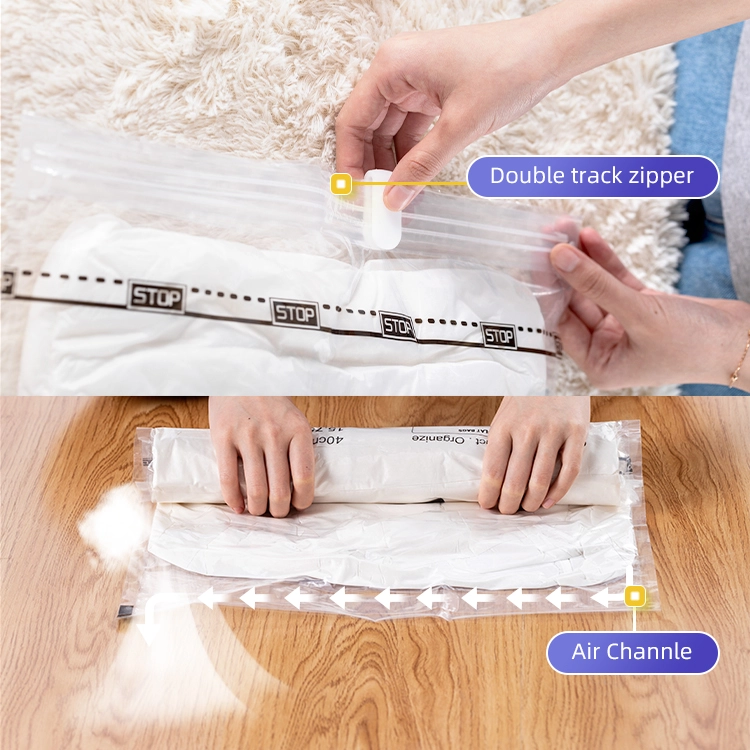
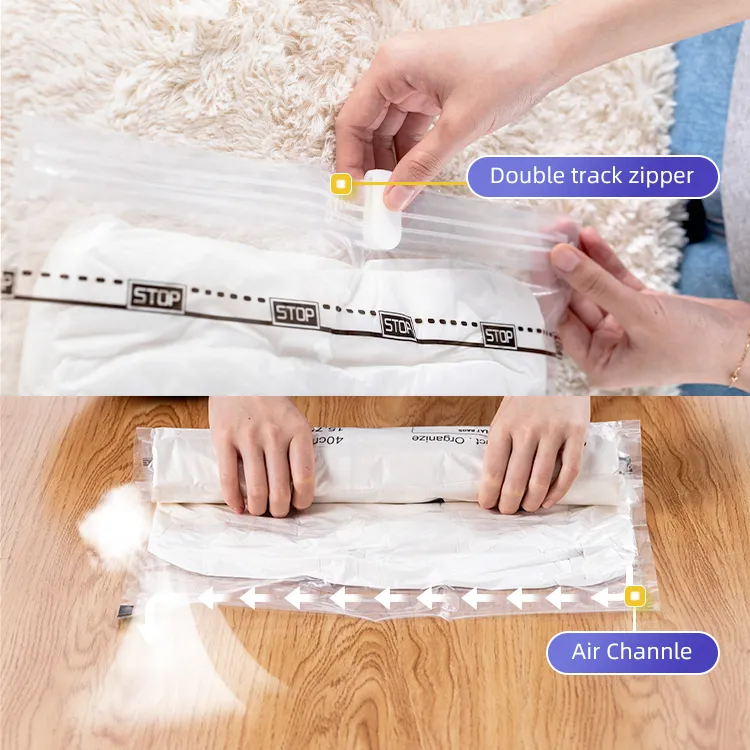
A typical manual pump connects to the valve and removes air through repeated strokes. It does not require electricity, but it does require a secure connection and continued physical input.
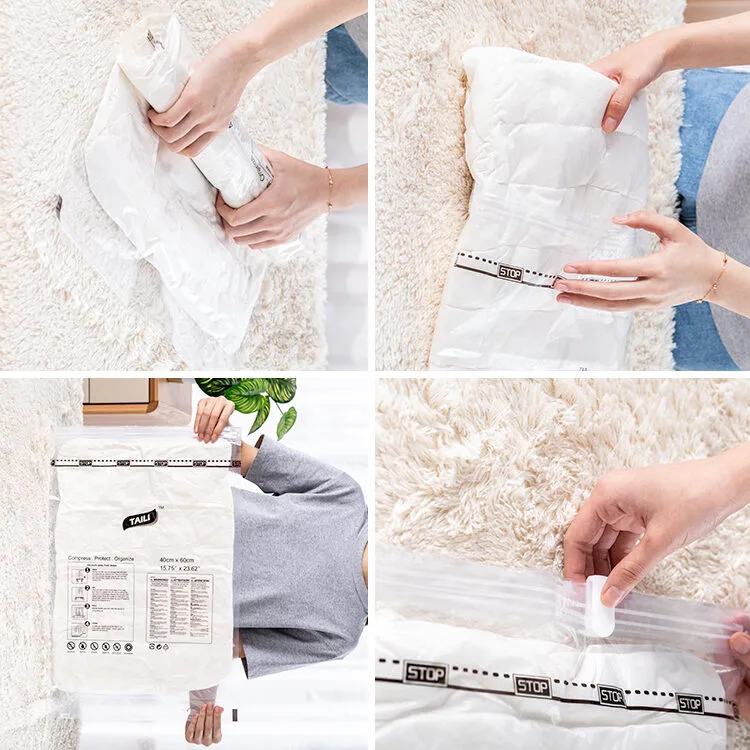
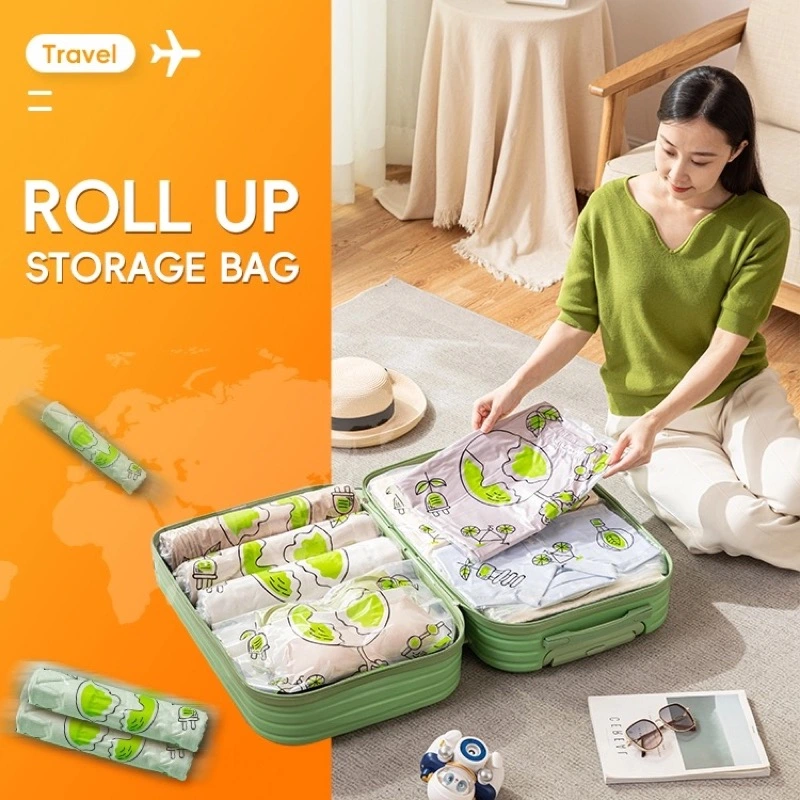
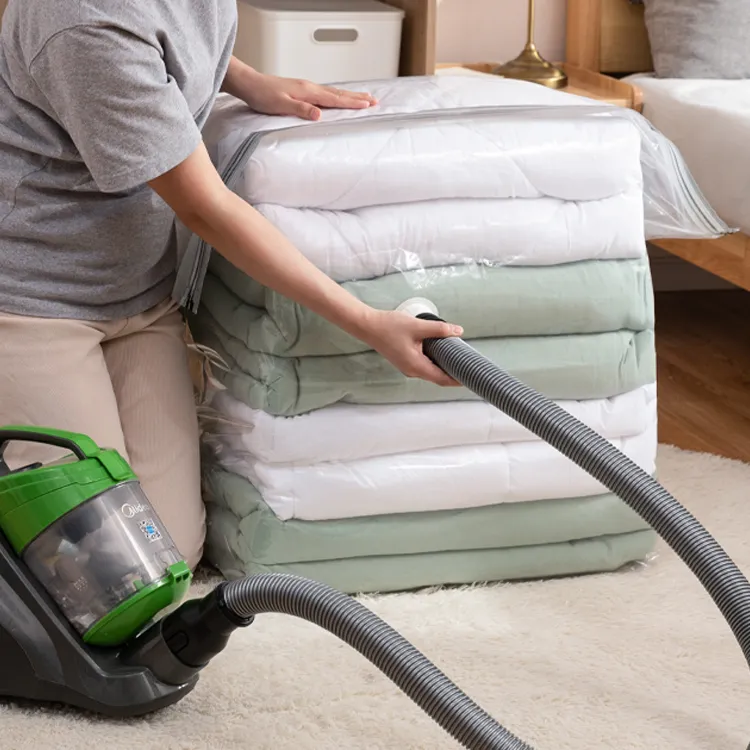
Manual pumping should not be confused with rolling or pressing a bag by hand. Some bags support those methods through a suitable valve; others require a pump. TAILI, for example, separately describes certain storage bags as supporting manual pressing or household-vacuum compression. That compatibility should not be assumed for every travel model.
Compression Performance: Does Electric Always Mean Better?
Compare the final packed result
An electric pump may remove air more conveniently, but “electric” is not a standardized compression rating.
The practical result depends on:
- The pump’s airflow and achievable pressure difference.
- The valve’s resistance and compatibility.
- The clothing’s compressibility.
- The zipper and seam integrity.
- How evenly the bag is filled.
A bag of fleece and T-shirts will behave differently from one containing structured jackets and densely folded denim. Comparing the two without controlling the contents tells you little about pump performance.
For buyers, the useful question is not simply, “Which pump is stronger?” It is, “Which complete system gives me a manageable packed shape and keeps it?”
Air retention deserves a separate test
Pumping removes air; the closed bag must then limit air re-entry. These are different functions.
If a compressed bag expands, inspect the closure, valve, and film before assuming the motor lacks power. Product instructions commonly emphasize fully closing the zipper, maintaining a proper pump connection, and securing the valve after compression.
A sensible evaluation therefore measures both immediate compression and retention after several hours.
Packing Speed, Effort, and Everyday Convenience
Electric pumps suit repeated packing
The main advantage of electric pumping is reduced manual work. That becomes more meaningful when packing several bags or reopening them throughout a multi-stop trip.
However, motor runtime is only part of the process. You still need to arrange clothing, clear the zipper, close the bag, connect or position the pump, and finish the valve closure.
Automatic shutoff should not be assumed. One rechargeable-pump manual, for example, instructs the user to maintain contact with the valve and switch the pump off manually after compression.
For travelers with limited hand strength or wrist discomfort, reduced pumping effort may be valuable. Check the controls and valve attachment too: an awkward connector can undermine an otherwise convenient design.
Manual pumps suit smaller packing tasks
For one small bag on an occasional weekend trip, manual pumping may be a reasonable compromise.
Its appeal is straightforward:
- No charging schedule.
- No charging cable.
- No battery capacity to check.
- No dependence on an available outlet.
The trade-off becomes clearer as bag count increases. A pump that feels acceptable for one pouch may feel inconvenient when the entire family needs to repack.
Portability, Battery Planning, and Air Travel
Compare total system weight
Do not compare a lightweight bag without its manual pump against a bag that already contains its electric hardware.
Use the complete travel setup:
Bags + pump hardware + required adapters + charging cable.
An integrated pump reduces the chance of forgetting a separate accessory. Conversely, one detachable pump may serve multiple compatible bags without duplicating motors and batteries.
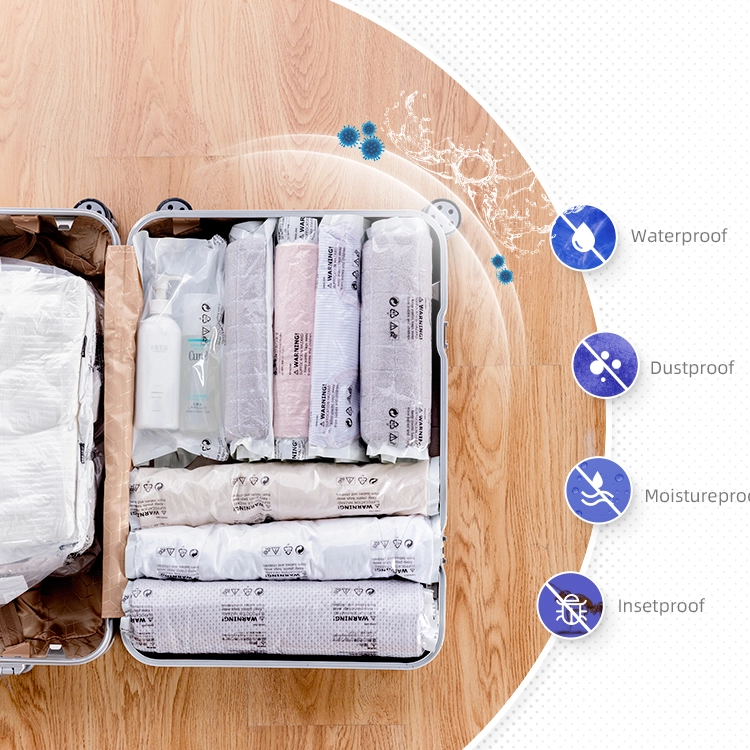
Compression primarily saves space, not clothing weight. A smaller-looking suitcase can still exceed an airline’s baggage allowance.
Check battery rules before flying
U.S. Federal Aviation Administration guidance recommends carrying lithium-battery-powered portable devices in carry-on baggage. Where permitted in checked baggage, these devices must be completely switched off and protected against damage and accidental activation. Spare lithium batteries and power banks must remain in the cabin.
Do not assume that rules for a separate electronic pump automatically apply to a battery integrated into luggage. Device classification, battery removability, capacity, airline policy, and route can affect the requirements.
Check the actual product label and operating airline before departure.
Keep an inspection recovery plan
The U.S. Transportation Security Administration allows vacuum-sealed clothing bags in carry-on and checked baggage, but says they are not encouraged because officers may need to open them if they trigger an alarm.
Keep the pump accessible when appropriate, and avoid packing so tightly that inspection leaves you unable to close your suitcase.
Reliability, Maintenance, and Long-Term Value
Integrated convenience can create repair trade-offs
An integrated electric design combines several components: bag, valve, motor, battery, switch, and charging interface.
That does not make it unreliable. It does mean you should understand what happens when one component needs service.
Ask whether:
- The motor module can be replaced independently.
- The battery is serviceable.
- The bag remains usable without electrical operation.
- The warranty covers both bag and pump.
- Replacement parts will remain available.
Manual pumps still need quality control
A manual pump avoids electrical faults, but its mechanical seals and connection points still matter.
Check for smooth movement, a comfortable grip, and a stable valve fit. Follow the manufacturer’s cleaning and storage instructions for either pump type.
Purchase price alone is an incomplete measure of value. Consider replacement availability, warranty support, and whether the system remains convenient enough to use repeatedly.
A Practical Home Test: Compare Both Pumps Fairly
Instead of relying on unqualified space-saving claims, run a controlled comparison.
Step 1: Standardize the clothing load
Use the same garments, folding method, and compatible bag wherever possible. If the bags differ, acknowledge that you are comparing complete systems rather than isolating pump performance.
Step 2: Time the complete packing process
Start before closing the zipper and stop when the bag is ready for the suitcase.
Record:
- Total packing time.
- Pumping time.
- Manual strokes, if applicable.
- Difficulty connecting the pump.
- Any need to reposition clothing.
Step 3: Check shape and air retention
Compare the compressed bag immediately, after two hours, and after 24 hours.
Use consistent photographs or a simple height measurement. This is a practical screening method, not a laboratory vacuum test.
Step 4: Repeat after reopening
Open the bag, remove an item, reseal it, and repeat. Travel involves repeated access, not one perfect compression cycle.
For commercial sourcing, apply the same test across several samples. One successful demonstration does not establish consistent production quality.
Which Pump Is Better for Your Travel Style?
Frequent business trips and multi-city travel
I would prioritize an electric system when repeated repacking is the main frustration. Confirm that the charging arrangement fits your routine and that the complete assembly packs neatly.
Occasional holidays and smaller budgets
A manual pump deserves consideration when you use only a few bags and do not mind the physical effort.
Compare actual kit prices rather than assuming every manual system costs less than every electric alternative.
Camping and travel with limited electricity
A manual pump removes charging from the planning process.
A rechargeable system can still work, but evaluate the manufacturer’s stated operating limits and your real repacking needs. Do not assume that every electrically pumped bag supports manual compression as a backup.
Family travel
Electric pumping may make a larger packing workload easier. Nevertheless, distributing clothing across practical-sized bags can matter more than choosing the strongest available pump.
Keep frequently needed items outside deeply compressed bundles.
What TAILI’s Materials Background Means for Buyers
TAILI’s published company information describes a business founded in 2003 with a focus on vacuum storage technology. It also describes cooperation with the China Astronaut Research and Training Center beginning in 2008.
That background provides relevant context, but it should not replace product-level evaluation.
For travel vacuum bags, translate manufacturing capability into specific questions:
- What materials and construction does this model use?
- How are seams, zippers, and valves inspected?
- What conditions support its compression claims?
- What repeated-use testing has been completed?
- What documentation and after-sales support are available?
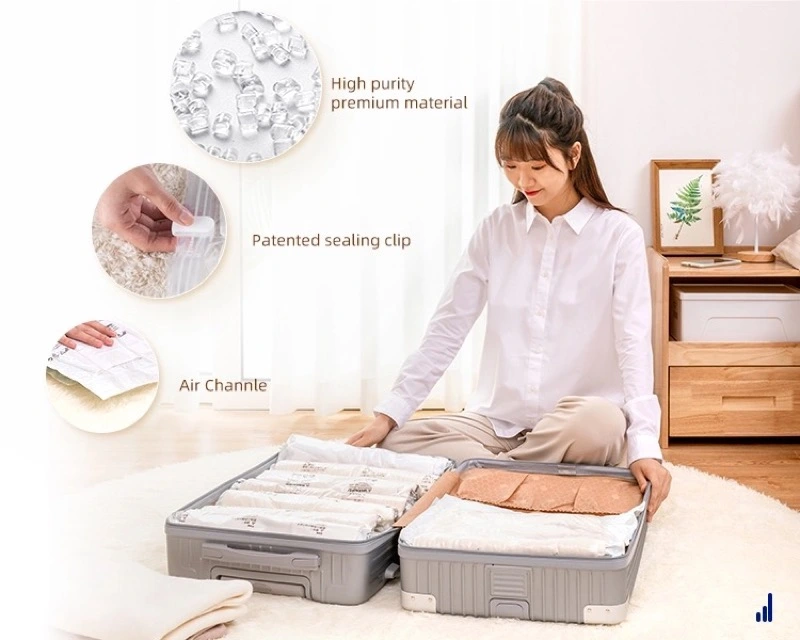
TAILI’s travel bag listing describes a nylon-and-TPU composite, reinforced edges, a zipper, and a leak-resistant valve. These are useful specifications to investigate, not independent proof that every model will perform identically.
For personal purchases or commercial sourcing, request evidence for the exact model under consideration rather than extending corporate credentials to every product claim.
Final Recommendation and Next Step
Choose a built-in electric pump when reduced physical effort and frequent repacking justify the charging requirements and integrated hardware.
Choose a manual pump when electricity independence, a simpler mechanism, and occasional use matter more.
Before ordering, request the exact pump configuration, complete system weight, compatibility instructions, battery information where applicable, and warranty terms. For a TAILI inquiry, specify your suitcase dimensions, typical clothing load, and travel frequency so the recommendation addresses your actual packing needs.

Frequently Asked Questions
1. Do electric pumps compress travel vacuum bags more than manual pumps?
Not necessarily. Pump capability, valve fit, clothing type, and bag construction all influence the result. Compare matched loads rather than relying on the power source alone.
2. Can I use a manual pump with an electric-pump bag?
Only if the manufacturer confirms compatibility. Integrated valves and connectors are not automatically interchangeable.
3. Are built-in electric pumps the same as rechargeable pumps?
No. “Built-in” describes integration with the bag. “Rechargeable” describes the power supply. A separate pump can also contain a rechargeable battery.
4. Can airport security open vacuum-packed clothing?
Yes. U.S. security guidance says vacuum-sealed bags may need to be opened for inspection if they trigger an alarm.
5. Why does my vacuum bag expand after packing?
Check whether the zipper is fully closed, the valve is secured, and clothing obstructs the closure. Inspect for damage and follow the model’s troubleshooting instructions.
6. Which option is better for frequent repacking?
An electric pump is generally the more convenient choice when repetitive hand pumping is the problem. Evaluate the entire packing routine, including charging and valve handling.
References
1. TAILI. “About.” Company history, vacuum-storage focus, and aerospace-development cooperation. https://en.zs-taili.com/home/page/index/1
2. TAILI Store. “TAILI Travel Vacuum Compression Bags with Wireless Pump.” Product construction and included-pump description. https://tailistore.com/products/taili-travel-vacuum-compression-bags-with-wireless-pump
3. TAILI Store. “TAILI Clear Extra Large Cube Vacuum Storage Bags.” Model-specific manual and vacuum compression methods. https://tailistore.com/products/taili-extra-large-cube-vacuum-storage-bags
4. NOBL Travel. “Vacuum Travel Compression Set Manual.” Pump operation, zipper closure, valve connection, and shutdown instructions. https://nobltravel.com/pages/nobl-manuals-vacuum-travel-compression-set
5. Federal Aviation Administration. “PackSafe—Portable Electronic Devices Containing Batteries.” Carry-on guidance, checked-baggage precautions, and spare-battery restrictions. https://www.faa.gov/hazmat/packsafe/portable-electronic-devices-with-batteries
6. Transportation Security Administration. “Vacuum-Sealed Bags.” Carry-on and checked-baggage screening guidance. https://www.tsa.gov/travel/security-screening/whatcanibring/items/vacuum-sealed-bags-0
Hot Tags: Travel Vacuum Bags, Vacuum Storage Bags Manufacturer, Vacuum Compression Bags Supplier, Wholesale Travel Vacuum Bags, OEM Vacuum Storage Bags, Custom Vacuum Compression Bags, Electric Pump Vacuum Bags, Manual Pump Vacuum Bags, Rechargeable Vacuum Pump, Bulk Vacuum Storage Bags