Content Menu
● How Does a Vacuum Roll Up Bag Seal?
● Why Is My Vacuum Roll Up Bag Not Sealing Properly?
● How to Fix a Vacuum Roll Up Bag That Does Not Seal
>> 1. Empty the Bag and Inspect the Zipper
>> 2. Clean the Sealing Tracks Gently
>> 3. Reduce the Load and Leave Closure Space
>> 4. Close the Zipper on a Flat Surface
>> 5. Roll Toward the Designated Air Outlet
>> 6. Observe the Bag Before Packing It Away
● A Controlled Test to Separate Packing Problems From Bag Defects
>> Test With One Soft, Dry Towel
● How to Inspect the Film, Seams, and Air Outlet
>> Check the Bag Body Against a Light Background
● Can You Repair a Leaking Roll Up Compression Bag?
● Prevent Repeat Sealing Problems
>> Pack Clean, Completely Dry Textiles
>> Protect the Film and Closure
>> Check Before Every Important Trip
● What Materials Expertise Means for Everyday Bag Reliability
● What to Send Taili When a Bag Still Will Not Seal
>> 1. Why Does My Vacuum Roll Up Bag Inflate Again?
>> 2. Can I Close a Roll Up Bag Without Its Slider?
>> 3. Do All Roll Up Vacuum Bags Need a Pump?
>> 4. How Much Space Should I Leave Below the Zipper?
>> 5. Should I Roll Harder If Air Will Not Come Out?
>> 6. Can a Roll Up Bag Be Reused After It Leaks?
If your vacuum roll up bag does not seal properly, start by reopening the zipper, removing trapped fibers, reducing the contents, and resealing it on a flat surface. Then roll the bag toward its designated air outlet, following the instructions for your specific model.
My recommended approach is to diagnose the problem before applying more pressure. A zipper that will not close, a bag that will not release air, and a bag that gradually reinflates can have different causes.
This guide explains how to identify each problem, restore a reliable seal, and decide when replacement makes more sense than another repair attempt.
How Does a Vacuum Roll Up Bag Seal?
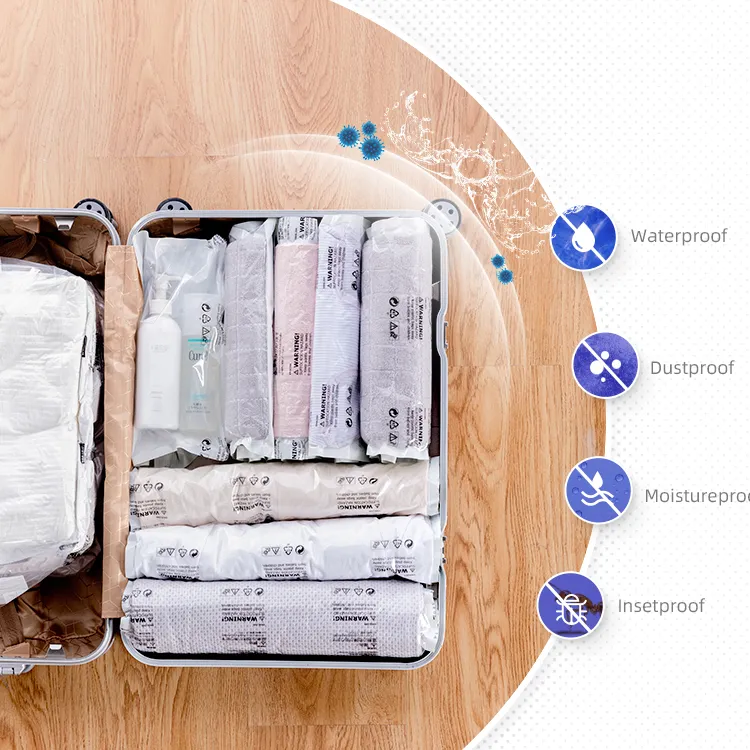
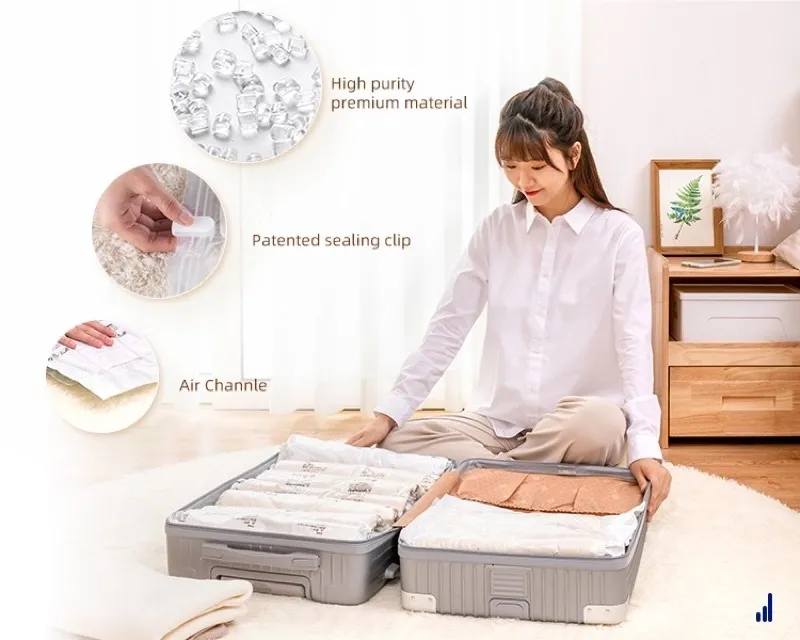
A travel roll up compression bag usually combines three working elements:
- A resealable zipper that closes the loading opening.
- Flexible film that contains your clothing.
- A one-way outlet that allows air to escape during compression.
Unlike pump-operated vacuum storage bags, many roll up bags have an outlet integrated into an end seam. They may not have a visible screw cap.
Once the zipper is closed, rolling pushes air toward the outlet. The outlet then restricts air from returning.
This distinction matters: instructions for a capped vacuum valve do not automatically apply to a seam-integrated roll up design. Identify your bag type before troubleshooting.
Why Is My Vacuum Roll Up Bag Not Sealing Properly?
The quickest way to narrow down the cause is to describe what happens.
| What you notice | Possible cause | First action |
|---|---|---|
| Zipper separates while closing | Overfilling or trapped fabric | Remove items and clear the closure |
| Slider moves, but gaps remain | Zipper tracks are not fully engaged | Press the entire closure together |
| Bag balloons during rolling | Air outlet is obstructed or rolling direction is incorrect | Check instructions and uncover the outlet |
| Bag compresses, then expands | Incomplete closure, damaged outlet, or puncture | Reseal and inspect systematically |
| Problem appears with one particular load | Uneven packing or excessive bulk | Repack with fewer, flatter items |
These symptoms are clues, not definitive proof. Check one variable at a time rather than assuming the entire bag is defective.
How to Fix a Vacuum Roll Up Bag That Does Not Seal
1. Empty the Bag and Inspect the Zipper
Remove the contents and lay the bag on a clean, firm surface.
Check both sides of the zipper for:
- Hair, lint, or loose threads.
- Fabric caught between the tracks.
- Creases that prevent alignment.
- Crushed, stretched, or separated zipper sections.
A slider reaching the end does not necessarily mean every part of the closure has engaged.
Pay particular attention to the corners. They are easy to overlook when closing a full bag.
2. Clean the Sealing Tracks Gently
Remove visible debris with clean fingers or a soft cloth. If necessary, use a lightly dampened cloth, then allow the closure to dry completely.
Unless the manufacturer specifically recommends them, avoid oils, lubricants, solvents, and abrasive cleaning tools. The objective is to remove contamination, not change the sealing surface.
Do not scrape the zipper with a pin or knife. A small cleaning problem can become permanent damage.
3. Reduce the Load and Leave Closure Space
Overfilling can pull the zipper tracks apart or make them difficult to align.
Remove a few garments and leave a clear strip between the contents and the opening. Manufacturer guidance commonly recommends a couple of inches of space, although the printed fill line and model instructions should take priority.
Fold clothing into an even layer. Move thick seams, buttons, and bulky waistbands away from the zipper.
Choose a larger bag if you must pull the opening together under tension.
4. Close the Zipper on a Flat Surface
Align the tracks before moving the supplied slider.
Run it from end to end with steady pressure, repeating two or three times where the product instructions recommend this. Then press along the full zipper between your thumb and finger.
This final check can reveal a short unclosed section that the slider missed.
If the closure repeatedly opens at the same location when the bag is lightly loaded, inspect that area for damage rather than continuing to force it.
5. Roll Toward the Designated Air Outlet
Find the rolling arrows or locate the outlet described in the instructions.
For designs with an outlet opposite the zipper, rolling generally proceeds from the closed zipper toward that outlet. Other constructions may differ.
Roll slowly and evenly. Keep clothing from bunching over the exit channel.
If the bag balloons instead of releasing air, stop. Unroll it, check the direction, and redistribute the contents. Jumping on the bag or applying sudden force is not a troubleshooting method.
6. Observe the Bag Before Packing It Away
After compression, leave the bag somewhere visible for about 15–30 minutes. Check again later if you need confidence before a trip.
Look for substantial expansion rather than expecting every fold to remain perfectly flat.
A modest change in shape does not, by itself, identify a leak. Repeated expansion toward the original volume warrants another inspection.
This observation period is a practical screening step, not a guarantee of long-term airtightness.
A Controlled Test to Separate Packing Problems From Bag Defects
An especially useful troubleshooting step is a simple comparison test.
This is a suggested home diagnostic exercise, not a published laboratory standard.
Test With One Soft, Dry Towel
- Place one small, fully dry towel inside the suspect bag.
- Keep the towel clear of the zipper and outlet.
- Close the zipper carefully.
- Compress the bag according to its instructions.
- Observe whether it remains reasonably compressed.
- If available, repeat with a known-working bag of the same design.
Keep the loading and observation conditions similar.
If the suspect bag works with the towel but fails with your usual clothing, revisit load size, packing shape, and outlet obstruction.
If it repeatedly fails under the lighter load while the comparison bag holds, a product fault becomes more plausible.
The value of this test is control: changing several conditions at once makes the result harder to interpret.
How to Inspect the Film, Seams, and Air Outlet
Check the Bag Body Against a Light Background
Empty the bag and inspect both sides under good lighting.
Look for punctures, abrasion, splits, and damage near sharp folds. Examine places that contacted suitcase hardware, clothing accessories, or rough storage surfaces.
Avoid dragging the bag across a floor while checking it.
Not every leak will be visible. A clean-looking film surface does not eliminate a zipper or outlet problem.
Inspect the Welded Edges
Check the seams around the perimeter, especially near corners and the loading opening.
An opening in a welded seam requires a different response from an unclosed zipper. Repeatedly running the slider will not repair it.
Do not try to reseal a clothing storage bag with an iron or a food vacuum sealer unless the manufacturer explicitly approves that method.
Keep the Outlet Accessible
A seam-integrated outlet can be difficult to recognize.
Check that clothing is not blocking it and that the bag has not been folded tightly across the exit path before compression.
Do not cut, puncture, or pry open an outlet to improve airflow. If it appears damaged, request model-specific advice.
Can You Repair a Leaking Roll Up Compression Bag?
The answer depends on the location and extent of the damage.
| Problem | Appropriate next step |
|---|---|
| Lint in an otherwise intact zipper | Clean and reseal |
| Missing slider | Ask about a compatible replacement |
| Persistent zipper deformation | Request assessment or replacement |
| Small puncture away from seams | Ask whether an approved patch is available |
| Split seam or damaged outlet | Seek manufacturer support |
| Widespread wear or multiple leaks | Replace the bag |
Ordinary adhesive tape should not be treated as a dependable permanent repair.
A temporary patch may also conceal the original damage, making diagnosis harder. Photograph the problem before attempting any repair, particularly if you plan to request warranty support.
For travel, use a known-working bag rather than relying on an uncertain repair.
Prevent Repeat Sealing Problems
Pack Clean, Completely Dry Textiles
Use the bag for items permitted by its instructions.
Do not assume a clothing compression bag is suitable for food, liquids, wet swimwear, or products requiring sterile storage.
Check garment-care requirements before compressing delicate or structured items. Down-filled products may need special handling; some storage-bag manufacturers advise against fully compressing them.
Protect the Film and Closure
Keep sharp accessories away from the bag wall. Avoid dragging compressed bags over rough surfaces or placing them against exposed suitcase hardware.
Store empty bags flat when practical, and avoid sharply folding the zipper.
When removing contents, open the closure gently instead of pulling forcefully on the film.
Check Before Every Important Trip
A brief inspection is easier than repacking at the airport.
Clean the closure, examine the seams, and test compression before departure. Remember that reducing volume does not reduce luggage weight.
What Materials Expertise Means for Everyday Bag Reliability
A roll up bag is a small system: film, zipper, welded seams, outlet design, and packing conditions all influence performance.
From a product-development perspective, evaluating only film thickness misses the bigger picture. A bag also needs a closure users can engage consistently and an air-release pathway that works with the intended load.
Guangdong Taili Technology Group Co., Ltd., founded in 2003 and headquartered in Zhongshan, combines vacuum-storage experience with materials development. Its published company history also describes participation in aerospace product development and work on an industry standard for vacuum compression storage bags.
That background provides relevant context, but it should not be interpreted as proof that every consumer bag carries aerospace certification or identical performance specifications.
For an individual product, prioritize its instructions, intended application, documented features, and support terms.
What to Send Taili When a Bag Still Will Not Seal
If cleaning, lighter loading, and correct rolling do not solve the problem, contact your seller or Taili support with:
- The product model and bag size.
- Your order information.
- Clear photographs of the zipper, seams, and outlet.
- A short video showing closure and compression.
- A description of when expansion occurs.
- The result of your light-load comparison test.
This information helps distinguish an operating issue from a damaged component.
Before replacing your vacuum roll up bag, complete one careful clean–reseal–repack cycle. If it still fails, request model-specific troubleshooting or a replacement assessment instead of repeatedly forcing the seal.
Frequently Asked Questions
1. Why Does My Vacuum Roll Up Bag Inflate Again?
Possible causes include an incompletely closed zipper, trapped fibers, a puncture, seam damage, or an outlet problem. Start with the zipper and a lighter load, then inspect the remaining components.
2. Can I Close a Roll Up Bag Without Its Slider?
Some closures can be pressed together manually. However, the correct method depends on the design. Ask the manufacturer about a compatible replacement slider rather than using an unrelated clip.
3. Do All Roll Up Vacuum Bags Need a Pump?
No. Many travel roll up bags release air through a one-way outlet when rolled by hand. Pump-operated and hybrid designs also exist, so follow the instructions for your model.
4. How Much Space Should I Leave Below the Zipper?
Follow the fill line where provided. Otherwise, leaving a couple of inches between the contents and zipper is common manufacturer guidance. The closure should align without stretching the loaded bag.
5. Should I Roll Harder If Air Will Not Come Out?
No. First check the rolling direction, load distribution, and outlet position. Additional force does not correct a blocked pathway or an incorrectly closed zipper.
6. Can a Roll Up Bag Be Reused After It Leaks?
Yes, if the cause was removable debris or incorrect closure and the bag subsequently works properly. Persistent leakage, damaged seams, or a deformed zipper may require replacement.
References
1. Packmate US. “Using Packmate.” Manufacturer guidance on filling space, slider operation, flat-surface sealing, handling, and storing empty bags. https://packmate-storage.com/using-packmate/
2. Packmate. “FAQs.” Manufacturer explanations of seam-integrated travel-bag outlets, replacement sliders, reuse, and precautions for sharp objects and down-filled bedding. https://packmate.co.uk/pages/faqs
3. Packmate. “How to Use Vacuum Bags Properly and Save More Space.” Guidance on dry contents, closure inspection, roll-up operation, and a 15–30-minute observation period. Published September 7, 2026. https://packmate.co.uk/blogs/news/how-to-use-vacuum-bags-properly
4. Taili Group. “About Taili | 20+ Years of R&D & Innovation.” Company-published history covering its founding, aerospace cooperation, and vacuum compression storage bag standard-development activities. Corporate claims are presented as company statements, not independent product certification. https://www.taili-group.com/about-us/
5. Taili Group. “Vacuum Storage Bags Manufacturer | OEM & Wholesale.” Official company information on vacuum storage manufacturing, materials development, and international operations. https://www.taili-group.com/
Hot Tags: Vacuum Roll Up Bags, Vacuum Storage Bags, Travel Compression Bags, Roll Up Compression Bags, Vacuum Storage Bag Manufacturer, Vacuum Storage Bags Wholesale, Vacuum Storage Bag Supplier, Custom Vacuum Storage Bags, OEM Vacuum Storage Bags, Reusable Vacuum Storage Bags