Content Menu
● One-Way Valves and Screw-Cap Valves: What Is the Difference?
>> How a Screw-Cap Valve Works
● One-Way Valves vs. Screw-Cap Valves: Comparison Table
● Which Valve Offers Better Everyday Usability?
>> Handling Steps and Closure Errors
>> Instructions Matter as Much as Appearance
● Which Vacuum Bag Valve Holds Compression Longer?
>> Evaluate the Entire Sealing System
>> Do Screw Caps Provide Extra Protection?
● Pump Compatibility and Compression Speed
● A Practical Buyer Test: Compare Complete Bags, Not Labels
>> Step 1: Standardize the Contents
>> Step 2: Standardize Evacuation
>> Step 4: Repeat the Use Cycle
● Troubleshooting: Why Does a Vacuum Bag Reinflate?
>> Check the Valve Position and Contact Area
>> Inspect Film, Seams, and Handling Damage
● What Independent Product Testing Can—and Cannot—Show
● Choosing a Supplier: Taili’s Materials Perspective
● Which Valve Should You Choose?
>> 1. Are one-way valves better than screw-cap valves for vacuum bags?
>> 2. Can a vacuum bag stay sealed without a screw cap?
>> 3. Does a larger valve always remove air faster?
>> 4. Why does my vacuum storage bag expand overnight?
>> 5. Can clothing vacuum bags be used for food?
>> 6. Are cap-free valves completely automatic?
Choosing between one-way valves vs. screw-cap valves for vacuum bags seems straightforward: one closes automatically, while the other requires a twist. However, that comparison misses an important detail. A screw-cap valve can also contain a one-way mechanism. The real purchasing decision concerns how the complete valve assembly seals, operates, and performs alongside the bag’s film and zipper.
For households, the priorities are convenient compression and dependable storage. For retailers and distributors, they also include clear instructions, consistent manufacturing, and fewer avoidable returns.
This guide compares both designs for clothing and bedding storage, explains their limitations, and provides a practical evaluation framework. The central principle is system-level performance: judge the complete bag, not just the valve’s appearance.
One-Way Valves and Screw-Cap Valves: What Is the Difference?
How a One-Way Valve Works
A one-way valve allows air to leave the bag during evacuation while restricting air from flowing back inside.
Depending on the design, a flexible membrane or another internal sealing element responds to the pressure difference across the valve. Once suction stops, that element returns to its sealing position.
However, “one-way” describes airflow control—not necessarily the absence of a cap. Some one-way vacuum storage bag valves have removable covers. Others incorporate attached or rotating closures.
Similarly, a cap-free design does not always mean zero manual operation. Some products still require users to rotate an integrated valve component after compression.
How a Screw-Cap Valve Works
A screw-cap valve has a threaded closure that users open before evacuation and tighten afterward.
The cap’s function varies. It may contribute to the airtight seal, protect the internal mechanism, or provide an additional closure over a self-sealing valve.
For example, Neusu’s instructions describe a self-sealing valve that prevents immediate air entry while the user replaces the screw cap. This demonstrates why “one-way” and “screw-cap” are not mutually exclusive categories.
For a meaningful comparison, ask whether the product uses an automatic internal seal, a separate closure, or both.
One-Way Valves vs. Screw-Cap Valves: Comparison Table
The following comparison describes typical design considerations, not guaranteed performance differences between every product.
| Comparison point | One-way-focused or cap-free design | Screw-cap design |
|---|---|---|
| Airflow control | Internal mechanism restricts reverse airflow | May also contain a one-way mechanism |
| User operation | Can reduce handling steps; some require rotation | Usually requires opening and retightening the cap |
| Loose components | Fewer loose parts when the closure is integrated | Removable caps may become misplaced |
| Sealing reliability | Depends on sealing element, cleanliness, and assembly | Depends on internal seal and any cap-dependent sealing surfaces |
| Pump compatibility | Must match the specified suction interface | Must match the specified suction interface |
| Repeated use | Internal mechanism and attachment require evaluation | Threads, cap, internal seal, and attachment require evaluation |
| Main purchasing question | Does the valve reliably close as instructed? | What sealing role does the cap actually perform? |
Neither design automatically guarantees stronger suction, longer storage, or better durability.
Which Valve Offers Better Everyday Usability?
Handling Steps and Closure Errors
From a usability perspective, fewer necessary actions can make a product easier to operate. An integrated closure also removes the problem of finding somewhere to place a detachable cap.
Nevertheless, a simplified-looking valve can still confuse users if its open and closed positions are unclear.
A screw cap provides an obvious physical action: open, evacuate, and close. However, the user must complete that sequence correctly, and the design must tolerate repeated handling.
The better option is the one whose required actions users can understand and repeat reliably.
Instructions Matter as Much as Appearance
Useful instructions should explain:
- Whether to remove, loosen, or rotate the closure.
- Where to position the pump or vacuum hose.
- Whether an additional closing action is required afterward.
- How to reopen the bag.
- Which parts should not be removed.
Printed instructions are especially useful when packaging gets discarded. In its evaluation of Taili hanging vacuum bags, The Spruce specifically highlighted instructions printed on the bags.
For commercial buyers, instruction quality deserves a place in the specification—not merely in the artwork approval process.
Which Vacuum Bag Valve Holds Compression Longer?
Evaluate the Entire Sealing System
A reliable valve cannot compensate for an incompletely closed zipper or damaged film.
Air retention depends on several connected elements:
- The valve’s internal sealing surfaces.
- The valve-to-film attachment.
- The zipper closure.
- The bag’s seams and film condition.
- Packing and handling practices.
When a bag expands, the visible valve is not automatically the cause.
This distinction matters when comparing suppliers. A premium-looking cap may create a reassuring impression without proving that the complete bag retains compression better.
Do Screw Caps Provide Extra Protection?
They can, depending on the construction.
A cap may protect the valve opening or contribute an additional sealing interface. However, that benefit must be confirmed for the specific product. A decorative or protective cover is not equivalent to a tested secondary airtight seal.
Likewise, a cap-free valve should not be dismissed as less secure merely because it lacks a removable component.
Ask suppliers to explain the sealing architecture and provide relevant finished-product test results. Avoid treating “double protection” as a measurable specification unless the supplier defines and demonstrates it.
Pump Compatibility and Compression Speed
Valve type alone does not establish compatibility with every vacuum cleaner or handheld pump.
The suction tool must contact the valve correctly. Opening dimensions, contact surfaces, and any required adapter all matter.
Taili’s XXL flat vacuum bag instructions specify use with a standard vacuum cleaner. Other vacuum bag systems may require a dedicated handheld device.
Before ordering, confirm:
- Which pumps or vacuum cleaners are supported.
- Whether an adapter is required.
- How the nozzle should contact the valve.
- Whether the same instructions apply across all bag sizes.
Compression speed also requires a controlled comparison. Bag size, contents, initial packing, and suction equipment can change the result.
A valve advertised as “fast” should therefore be evaluated under stated conditions rather than compared through isolated demonstration videos.
A Practical Buyer Test: Compare Complete Bags, Not Labels
For distributors and procurement teams, the most useful additional step is a repeatable sample assessment.
The following framework is a proposed purchasing protocol, not a published industry standard.
Step 1: Standardize the Contents
Compare similar-sized bags using equivalent, clean, dry textiles.
Keep the item type, quantity, folding method, and position consistent. A loosely packed blanket and tightly folded shirts create different starting conditions.
Step 2: Standardize Evacuation
Use the same compatible suction equipment and follow each product’s instructions.
Record:
- Time required to prepare and close the bag.
- Time required to remove air.
- Any difficulty positioning the nozzle.
- Any uncertainty about the final valve position.
Separate compression time from total handling time. A fast-flowing valve may still involve a cumbersome closing process.
Step 3: Monitor Retention
Photograph and measure the compressed package immediately after sealing and at agreed intervals.
For an initial screening, buyers might choose 24 hours, seven days, and 30 days. These are suggested checkpoints, not universal pass criteria.
Package thickness can indicate expansion, but it does not measure vacuum pressure directly. Textile recovery and positioning can affect the reading.
Step 4: Repeat the Use Cycle
Open, refill, reseal, and evacuate each sample repeatedly.
Record loose components, difficult threads, uncertain closure, visible damage, and changes in retention. Set the required cycle count according to the intended product claim.
Testing several samples is more informative than relying on one successful demonstration.
Troubleshooting: Why Does a Vacuum Bag Reinflate?
Before rejecting either valve design, check the complete closure system.
Check the Zipper First
Inspect the full zipper length for incomplete closure, folds, or trapped fibers.
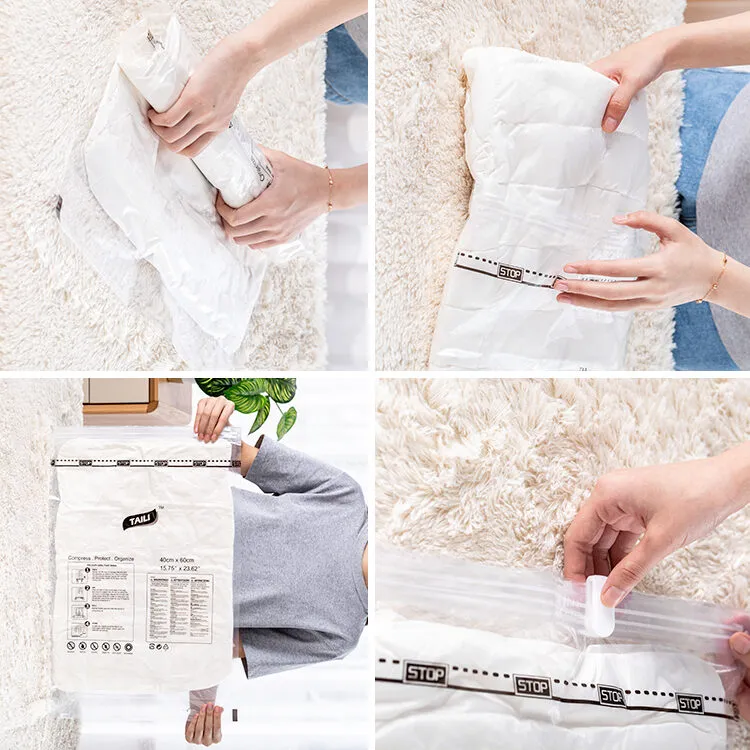
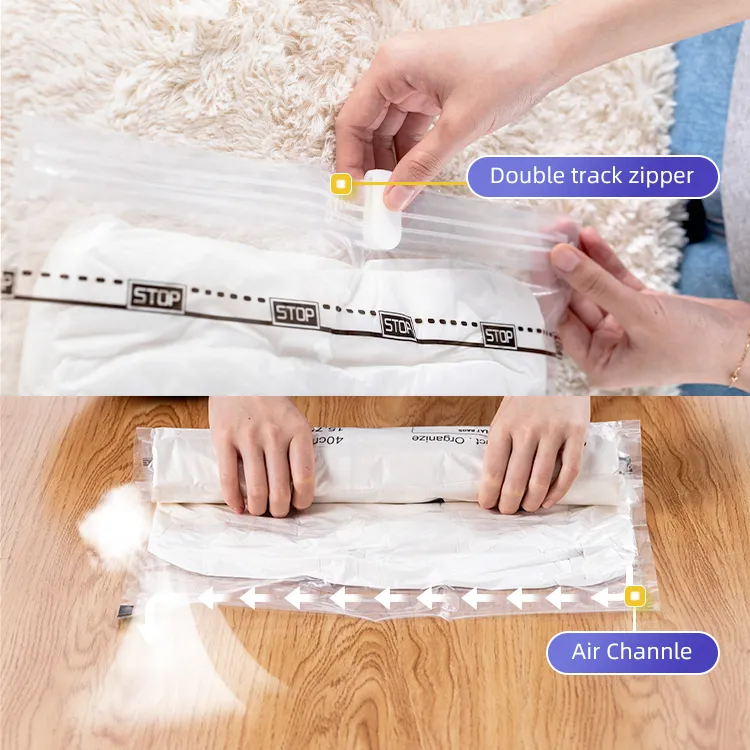
Follow the manufacturer’s instructions rather than assuming that one slider pass is sufficient. Taili’s XXL bag instructions recommend passing over the zipper two or three times.
Also respect the packing clearance. The same instructions specify leaving approximately 5–10 cm between the contents and zipper.
Check the Valve Position and Contact Area
Confirm that any required cap tightening or rotating action is complete.
Inspect accessible surfaces for lint or contamination, but do not dismantle a valve unless the manufacturer permits it. Neusu specifically warns users not to force its valve open.
Inspect Film, Seams, and Handling Damage
Look for punctures, abrasion, or damage around attachment points.
If a correctly repacked bag repeatedly expands, remove it from dependable long-term storage use and investigate the failed sample. Repeatedly evacuating it may hide the symptom without identifying the cause.
What Independent Product Testing Can—and Cannot—Show
Independent reviews provide useful evidence when they disclose observations and test conditions.
Better Homes & Gardens reported negligible expansion after 24 hours for the Taili hanging vacuum bags it evaluated. The Spruce also reported strong retention during its storage testing.
These observations support the performance of those evaluated products under those conditions. They do not establish that every Taili model performs identically or that one valve category universally outperforms another.
Similarly, a brief water-submersion observation does not establish suitability for prolonged immersion.
For buyers, the lesson is to connect each claim to the exact model, sample, duration, and method. Category-wide conclusions require broader comparative evidence.
Choosing a Supplier: Taili’s Materials Perspective
The company background supplied for this article presents Guangdong Taili Technology Group Co., Ltd. as a materials-focused manufacturer with capabilities spanning polymer technologies, coating, and finished-product production.
That background provides a relevant basis for discussing integrated product development. However, company-level credentials should remain distinct from model-specific performance evidence.
In particular, aerospace-related experience should not be presented as proof that every retail vacuum bag meets an aerospace specification.
For a meaningful supplier discussion, request:
- The proposed bag model and intended application.
- A clear description of the valve’s sealing mechanism.
- Film, zipper, and valve assembly specifications.
- Compatible suction equipment.
- Finished-bag retention and repeated-use test methods.
- Instructions and packaging appropriate to the target market.
This turns a broad capability discussion into a practical product qualification process.
Which Valve Should You Choose?
Choose a one-way-focused, integrated design when reducing loose parts and simplifying handling are important—provided its closing procedure is clear and validated.
Choose a screw-cap design when users prefer a familiar closure and the complete assembly performs well in the intended application.
For long-term storage, neither label should decide the purchase. Prioritize demonstrated retention, durable construction, and instructions that users can follow consistently.
For Taili product enquiries, share your target bag dimensions, intended contents, suction equipment, expected reuse frequency, and storage duration. Request representative samples and agree on acceptance criteria before placing a volume order.

Frequently Asked Questions
1. Are one-way valves better than screw-cap valves for vacuum bags?
Not inherently. A screw-cap valve may also contain a one-way mechanism. Compare usability, complete-bag retention, durability, and pump compatibility rather than relying on the label.
2. Can a vacuum bag stay sealed without a screw cap?
Yes, if its design provides the required seal without one. Some cap-free products still require a rotating closure action. Always follow the instructions for the exact model.
3. Does a larger valve always remove air faster?
No. Valve size alone does not determine compression speed. The internal airflow path, suction equipment, nozzle contact, bag size, and contents also affect the result.
4. Why does my vacuum storage bag expand overnight?
Possible causes include an incompletely sealed zipper, an incorrectly closed valve, contamination, or film damage. Check these areas systematically before assuming the valve design is defective.
5. Can clothing vacuum bags be used for food?
Do not assume so. Use products specifically intended for food contact and the required storage conditions. Neusu explicitly limits its referenced storage bags to textiles, while FoodSaver supplies purpose-designed food vacuum zipper bags.
6. Are cap-free valves completely automatic?
Not always. “Cap-free” can mean there is no detachable cap, rather than no closing step. Check whether the product requires rotation or another action after evacuation.
References
1. Neusu. “How to Use Vacuum Storage Bags Properly.” Manufacturer instructions covering screw caps, internal self-sealing operation, packing, maintenance, and textile-only use. https://www.neusu.com/help-advice/how-to-use-vacuum-storage-bags-properly/
2. Taili Store. “TAILI XXL Flat Cream Vacuum Storage Bags.” Product instructions covering vacuum-cleaner use, zipper clearance, repeated zipper closure, and valve operation. https://tailistore.com/products/taili-xxlflat-vacuum-storage-bags
3. The Spruce. “After Testing Vacuum Storage Bags, These 6 Are Our All-Time Favorites.” Independent product evaluation, including observations about Taili hanging bags, retention, and printed instructions. https://www.thespruce.com/the-best-vacuum-storage-bags-5224944
4. Better Homes & Gardens. “Save on Space with the 6 Best Vacuum Storage Bags We Tested.” Comparative product testing, including reported 24-hour retention observations for Taili hanging bags. https://www.bhg.com/best-vacuum-storage-bags-7567870
5. FoodSaver. “FoodSaver Reusable Quart Vacuum Zipper Bags, for Use with FoodSaver Handheld Vacuum Sealers, 10 Count.” Manufacturer information illustrating application-specific food vacuum bags and their stated uses. https://www.foodsaver.com/shop/vacuum-seal-bags-rolls/vacuum-seal-bags/zipper-bags/foodsaver-reusable-quart-vacuum-zipper-bags-for-use-with-foodsaver-handheld-vacuum-sealers-10-count/SAP_2193707.html
Hot Tags: Vacuum Storage Bags, Vacuum Bag Manufacturer, Wholesale Vacuum Bags, Vacuum Storage Bag Supplier, One-Way Valve Vacuum Bags, Screw-Cap Vacuum Bags, Custom Vacuum Storage Bags, OEM Vacuum Storage Bags, Bulk Vacuum Storage Bags, Reusable Vacuum Storage Bags