Content Menu
● Built-In vs. External Pumps: Quick Comparison
● How Travel Vacuum Compression Bag Pumps Work
● Compression Performance: Which Pump Saves More Space?
>> Clothing Determines the Available Savings
>> Pump Speed Is Not the Whole Packing Time
● Packing Convenience: One Bag or Several?
>> Compare Total System Weight and Bulk
● Reliability: Why the Seal Matters More Than Pump Location
>> Inspect the Whole Air-Retention System
● A Practical Home Test Before Your First Trip
● Battery Rules and Airport Screening
>> Rechargeable Pumps Require Additional Checks
● International Travel: Charging and Return-Trip Planning
● What Taili’s Materials Background Means for Buyers
● Which Pump Design Should You Choose?
>> Choose a Built-In Pump When Simplicity Comes First
>> Choose an External Pump When Flexibility Comes First
>> Consider a Pump-Free Alternative for Minimalist Travel
● Make Your Next Packing Decision With Evidence
>> Are built-in pumps better than external pumps?
>> Do vacuum compression bags reduce luggage weight?
>> Can one external pump work with different brands?
>> Can I use travel vacuum bags without electricity?
>> Why does my vacuum bag expand after packing?
>> Will security officers open vacuum-sealed clothing bags?
Choosing between built-in vs. external pumps for travel vacuum compression bags comes down to a practical question: do you want everything attached to one bag, or one separate pump that can serve several bags? A built-in pump keeps the compression mechanism with the bag. An external pump offers a modular setup, with the pump connected only when needed.
My decision framework starts with usability, not the biggest space-saving claim. Consider how you will repack in a hotel, reopen clothing during security screening, and manage a failed pump. Neither design automatically delivers better compression. The right choice depends on the complete system: bag construction, valve design, pump performance, and your travel routine.
Built-In vs. External Pumps: Quick Comparison
| Decision factor | Built-in pump | External pump |
|---|---|---|
| Basic design | Pump integrated into or permanently attached to the bag | Separate pump connects to the bag’s valve |
| Main advantage | Fewer separate accessories to remember | One compatible pump can serve multiple bags |
| Main drawback | Pump hardware stays with each equipped bag | Pump can be forgotten or misplaced |
| Power options | Model-dependent; confirm whether manual or electric | Manual, rechargeable, or externally powered |
| Compression performance | Depends on the specific system | Depends on the specific system |
| Replacement | Check whether the pump module is replaceable | Pump and bag can often be replaced separately |
| Best starting point | Travelers prioritizing an all-in-one routine | Travelers prioritizing flexibility and shared equipment |
These are design-level distinctions, not results from a controlled comparison of particular products. Before purchasing, check the actual specifications rather than relying on the category name.
How Travel Vacuum Compression Bag Pumps Work
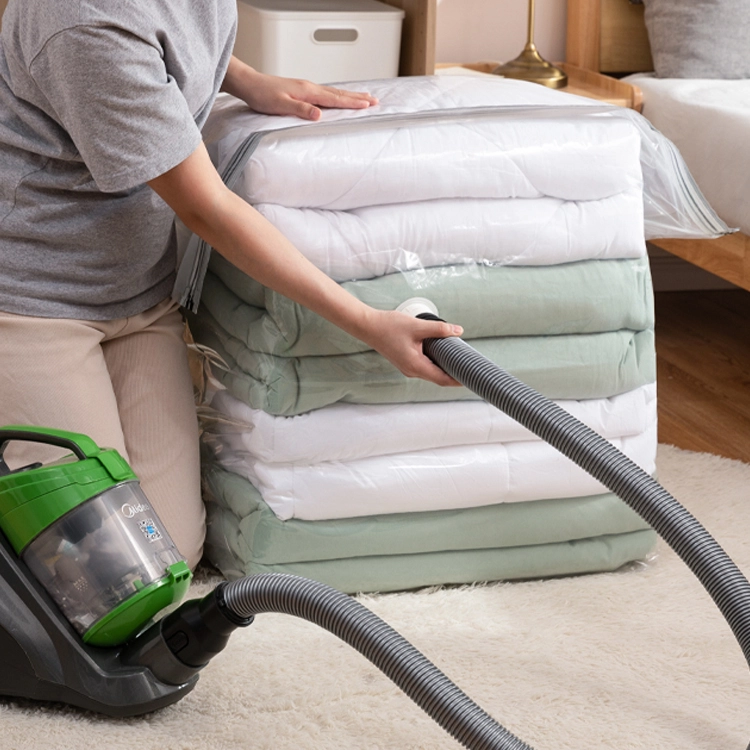
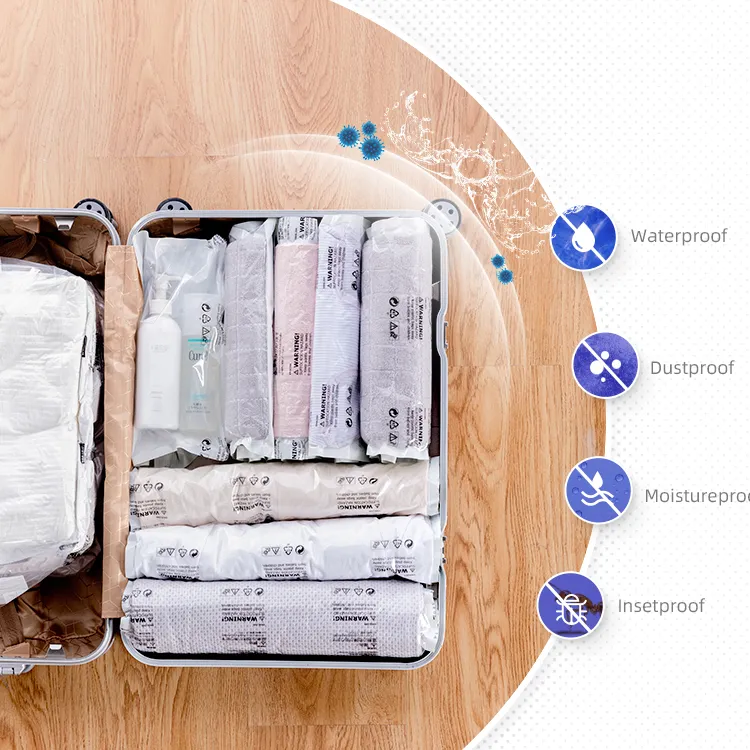
Vacuum compression removes air from a sealed bag, allowing atmospheric pressure to compress soft contents. The pump evacuates air; the closure and valve must then prevent it from returning.
That distinction matters. A powerful pump cannot compensate for a leaking zipper, damaged valve, or punctured film.
What Is a Built-In Pump?
A built-in pump forms part of the bag assembly rather than being a separately packed accessory. However, product descriptions do not always use “integrated” consistently. Sometimes the integrated component is only the valve or compression compartment.
Before ordering travel vacuum bags with a built-in pump, establish:
- Whether the pump is actually included and attached.
- Whether operation is manual or electric.
- Whether the pump or battery can be removed.
- Whether a backup compression method is supported.
What Is an External Pump?
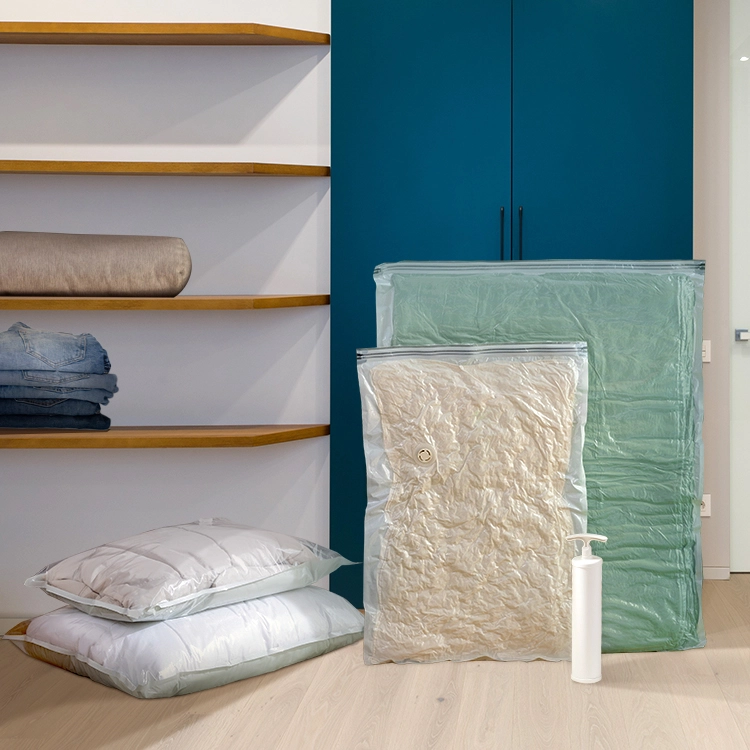
An external pump connects to a valve during compression and is then removed. Options include hand pumps, rechargeable mini pumps, and plug-in electric pumps.
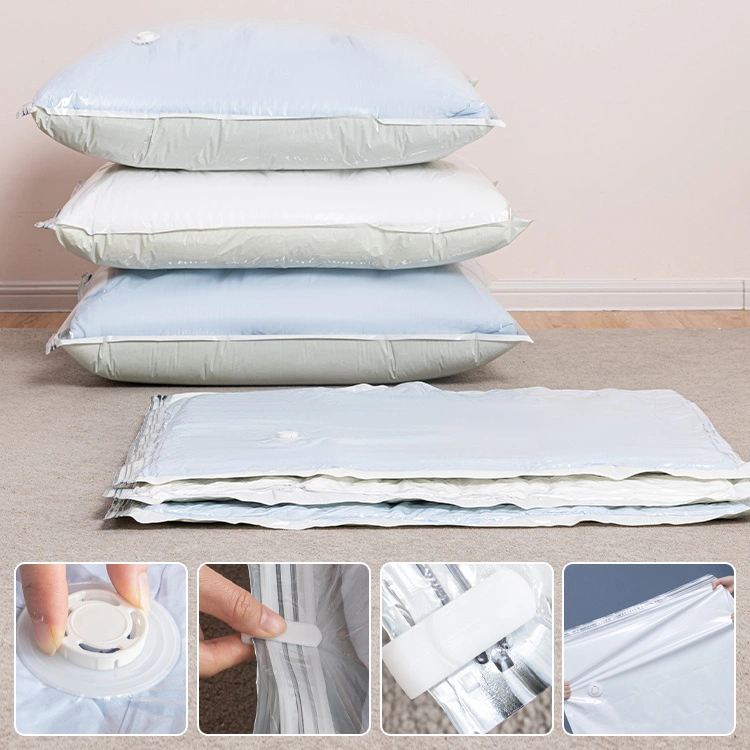
Compatibility is not universal. The nozzle must fit the valve correctly, and the manufacturer must approve the connection. A pump that physically touches a valve may still leak around the interface.
Compression Performance: Which Pump Saves More Space?
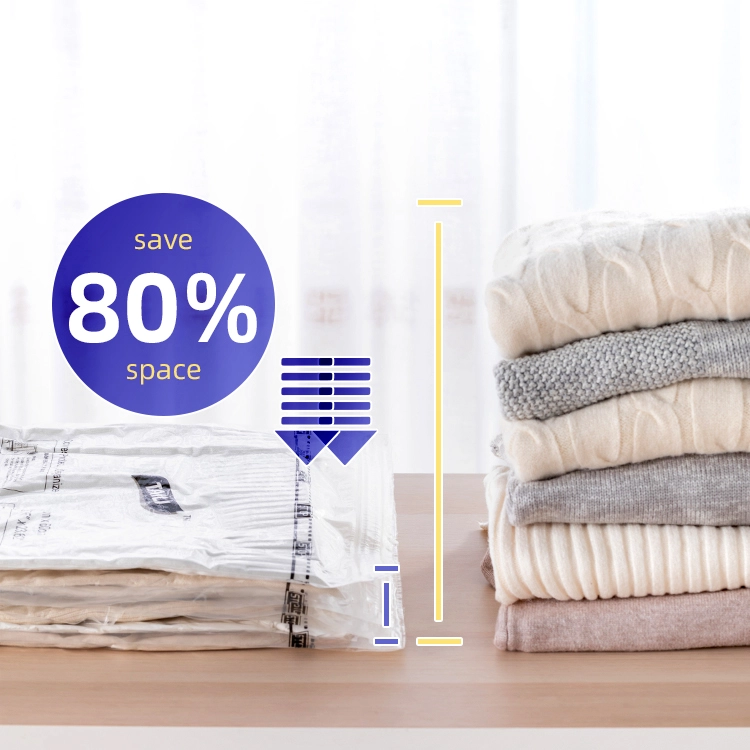
Neither built-in nor external pumps inherently save more space. Results depend on the clothing load, available airflow, achievable pressure, and the bag’s ability to retain compression.
Clothing Determines the Available Savings
Bulky, air-filled items offer more compression potential than already dense garments. A bag filled with fleece will behave differently from one containing tightly folded denim.
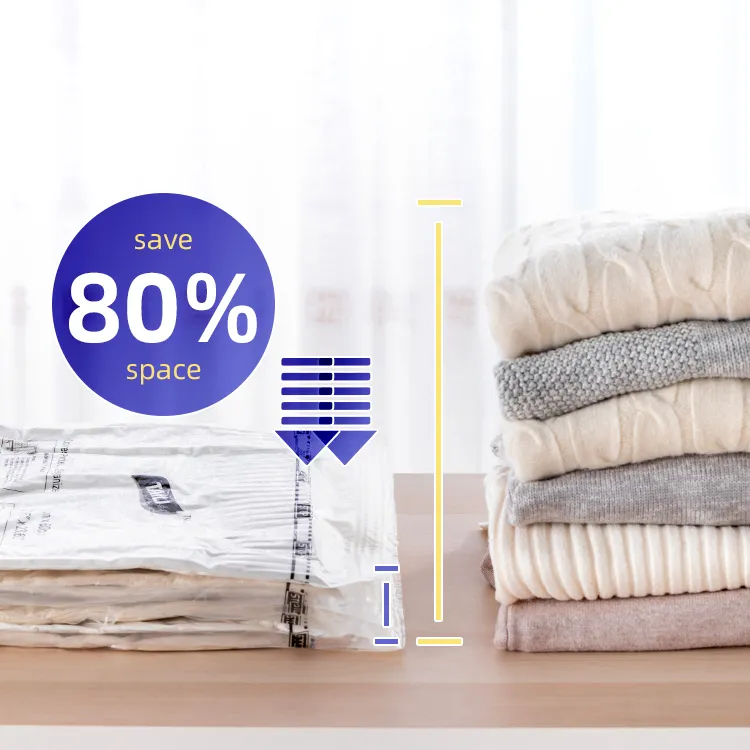
This makes percentage claims difficult to compare. Ask what was packed, how the original volume was measured, and whether the advertised reduction describes the clothing alone or the complete packed system.
Pump Speed Is Not the Whole Packing Time
Independent testing illustrates the variation between products. Travel + Leisure reported approximately five minutes of pumping for one hand-pump setup and around 90 seconds of operating time for a plug-in electric model. Those observations describe particular products and loads—not universal manual-versus-electric benchmarks.
For a useful comparison, time the entire task:
- Load and arrange the clothing.
- Close the bag correctly.
- Attach or activate the pump.
- Complete compression.
- Disconnect, close the valve, and stow the equipment.
A fast motor offers limited convenience if the nozzle is awkward or the closure requires repeated attempts.
Packing Convenience: One Bag or Several?
The strongest advantage of a built-in pump is logistical: it remains with its bag. That reduces the chance of reaching your destination with compressed clothing but no way to repack it.
For travelers repeatedly opening one clothing bag, this arrangement can simplify the routine.
An external pump becomes attractive when several compatible bags share one device. Instead of carrying pump hardware on every bag, you carry one pump and move it between valves.
Compare Total System Weight and Bulk
Do not compare an empty built-in bag with an external-pump bag while excluding the separate pump.
Compare:
- All bags required for the trip.
- Pump hardware.
- Charging cables or adapters.
- Protective cases and valve attachments.
The relevant outcome is the complete system inside your luggage. A protruding pump housing or bulky accessory pouch can offset part of the space gained through compression.
Reliability: Why the Seal Matters More Than Pump Location
From a product-evaluation perspective, I would separate two questions:
- Can the system remove air effectively?
- Can the bag keep that air out afterward?
Independent travel-bag testing found differences in overnight compression retention, including a tested bag that allowed some air back in. This demonstrates why initial flatness alone is an incomplete quality measure.
Inspect the Whole Air-Retention System
Examine the closure, welded seams, valve attachment, and film condition. Also check how easily you can confirm that the zipper is fully closed.
Neither a thicker-looking bag nor an aerospace-related brand statement establishes the performance of a particular travel product. Request model-specific evidence.
Repairability also deserves attention. An external system may allow separate pump replacement, provided a compatible replacement remains available. With a built-in system, ask whether a failed module can be serviced without discarding the bag.
A Practical Home Test Before Your First Trip
A repeatable trial is more informative than judging a bag immediately after unpacking it.
Use the Same Clothing Load
For an A/B comparison, use identical garments and a similar usable bag size. Fold the clothing consistently and avoid exceeding either manufacturer’s fill guidance.
Then record:
- Total preparation and compression time.
- Complete system weight.
- Packed dimensions inside your actual suitcase.
- Ease of opening and recompressing.
- Any visible expansion after several hours and overnight.
This is a practical screening method, not a standardized laboratory test. Its purpose is to expose problems before departure.
Evaluate Net Space Savings
Judge the final arrangement with pumps and accessories packed—not just the flattened clothing.
Also check whether the compressed bag creates an awkward rigid block. A slightly less compressed package may fit your suitcase layout better than a very dense package with unusable gaps around it.
Battery Rules and Airport Screening
Vacuum-sealed clothing bags are permitted in both carry-on and checked baggage under U.S. screening guidance, but officers may open them for inspection if they trigger an alarm. Keep a realistic plan for repacking afterward.
Rechargeable Pumps Require Additional Checks
For lithium-battery-powered portable devices, U.S. aviation guidance recommends carry-on transport. Devices placed in checked baggage must meet applicable requirements, including being completely switched off and protected against accidental activation and damage. Spare lithium batteries and power banks must remain in carry-on baggage. Airline and international restrictions can be stricter.
Do not assume that every integrated pump is treated identically. Ask the airline how it classifies the specific product, particularly when the battery is permanently attached to a bag.
A removable external pump can make separating electronics from checked clothing easier. A non-electric system avoids battery-management questions altogether.
International Travel: Charging and Return-Trip Planning
“Electric” does not necessarily mean rechargeable or suitable for overseas use.
For example, a commercially listed vacuum-bag set specifies a 110-volt pump that is incompatible with 220-volt power. A plug adapter alone does not resolve a voltage mismatch.
Before buying an electric travel vacuum pump, check:
- Input voltage and frequency.
- USB input requirements, if applicable.
- Whether it operates while connected to power.
- Charging time and stated operating capacity.
- Availability of an approved manual backup.
Plan for the return journey too. Leaving a plug-in pump at home may save outbound space but make recompression impossible at your destination.
What Taili’s Materials Background Means for Buyers
Taili’s published company history describes its vacuum-storage specialization, founding in 2003, and cooperation with China’s astronaut research and training organization on aerospace-related products. This background gives buyers a relevant reason to examine its material and sealing capabilities.
However, corporate experience and product-level proof are different things. Aerospace cooperation does not automatically mean every consumer travel bag carries an aerospace certification.
For a Taili travel vacuum compression bag—or any competing model—I would request:
- Film construction and material specifications.
- Closure and valve instructions.
- Compression-retention test conditions.
- Repeated opening-and-closing test results.
- Pump replacement and warranty terms.
- Battery documentation for rechargeable models.
This turns a broad technology story into evidence relevant to daily travel.
Which Pump Design Should You Choose?
Choose a Built-In Pump When Simplicity Comes First
Start with built-in options when you mainly use one bag, want fewer loose accessories, and prefer a self-contained packing routine.
Before committing, confirm the complete weight, pump serviceability, and any battery-removal limitations.
Choose an External Pump When Flexibility Comes First
Start with an external pump when several compatible bags will share it, different family members need compression, or replacing components separately matters.
Check compatibility across the exact bags you intend to use. “Universal” should be supported by clear valve and adapter information.
Consider a Pump-Free Alternative for Minimalist Travel
Roll-up compression bags offer another approach: air is expelled by rolling or pressing rather than attaching a pump. Independent testing identifies this as an accessory-free option, although performance and effort vary by design.
The right answer may therefore be neither pump category if your priority is eliminating equipment.
Make Your Next Packing Decision With Evidence
Before choosing a Taili travel compression solution, prepare your suitcase dimensions, typical clothing load, number of bags, and preferred power source. Request the matching product specifications, pump-compatibility details, and care instructions.
Then test the complete setup before departure. Buy the system that remains convenient when you reopen it—not merely the one that looks smallest in a product photograph.
Frequently Asked Questions
Are built-in pumps better than external pumps?
Not automatically. Built-in pumps prioritize an all-in-one arrangement. External pumps prioritize modularity. Compare complete system size, compression retention, operating effort, and repairability.
Do vacuum compression bags reduce luggage weight?
They reduce bulk, not the weight of your clothing. Bags and pumps add their own weight. Weigh the finished suitcase instead of assuming that a smaller package is lighter.
Can one external pump work with different brands?
Sometimes, but compatibility must be verified. Check the valve interface, nozzle fit, approved adapters, and manufacturer instructions before purchasing.
Can I use travel vacuum bags without electricity?
Yes, if the chosen system supports a manual pump or pump-free compression. Do not assume an electric-only bag supports either method.
Why does my vacuum bag expand after packing?
Possible causes include an incompletely closed zipper, an improperly seated valve, or damage. Recheck the closure and inspect the bag according to its instructions before blaming the pump.
Will security officers open vacuum-sealed clothing bags?
They may. U.S. screening guidance allows these bags but states that officers may open them for inspection when they alarm. Leave enough flexibility to repack.
References
1. Travel + Leisure. “The 6 Best Vacuum Bags for Travel, Tested and Reviewed.” Independent product observations covering compression methods, operating time, seal retention, and packing considerations. https://www.travelandleisure.com/travel-vacuum-bags-6753391
2. Transportation Security Administration. “Vacuum-sealed bags.” Official U.S. screening guidance for carry-on and checked baggage. https://www.tsa.gov/travel/security-screening/whatcanibring/items/vacuum-sealed-bags-0
3. Federal Aviation Administration. “PackSafe—Portable Electronic Devices Containing Batteries.” Guidance on device transport, accidental activation, and damage protection. https://www.faa.gov/hazmat/packsafe/portable-electronic-devices-with-batteries
4. Federal Aviation Administration. “PackSafe—Lithium Batteries.” Guidance on spare batteries, power banks, and airline-specific restrictions. https://www.faa.gov/hazmat/packsafe/lithium-batteries
5. Target / SpaceAid. “14 Pack Vacuum Storage Bags with Electric Air Pump.” Product information and supplier responses concerning pump operation and voltage compatibility. https://www.target.com/p/14-pack-spaceaid-vacuum-storage-bags-with-electric-air-pump-space-saver-sealer-for-comforters-blankets-pillows-bedding-clothes-compression-bags/-/A-92871144
6. Taili. “About.” Company-published background on vacuum-storage technology and aerospace-product cooperation; a corporate source, not independent verification of individual product performance. https://en.zs-taili.com/home/page/index/1
Hot Tags: Travel Vacuum Compression Bags, Vacuum Compression Bag Manufacturer, Vacuum Storage Bag Supplier, Wholesale Travel Vacuum Bags, OEM Vacuum Compression Bags, ODM Vacuum Storage Bags, Custom Travel Compression Bags, Built-In Pump Vacuum Bags, External Pump Vacuum Bags, Travel Vacuum Pump Manufacturer